There has been a massive uptick of interest in my poetry.
When I say “massive,” I mean a 600% increase in people visiting the website where I published my absurdist poem from 1997 about systems thinking and the nature of time. The poem is called “Chronosphere.”
Of course, that massive increase was starting from a very low baseline. On average, about one person per week visits that website. But when I recently published an article about how an AI-empowered scammer almost got to me, by pretending to be a major publisher, who wanted to acquire the rights to my book The Chronosphere Commentary, six people visited the website in a single week. That is a 600% increase over normal.
I choose to interpret this as a signal that I should reintroduce you to that book, and that poem.
The poem “Chronosphere” is nearly 30 years old. It is serious poetry, but it is also absurdist poetry. The 61 stanzas are written in a ragtag mix of styles that blend the silly with the obscure, alternating laments with epiphanies, moments of boredom with flights of hope. It was dedicated to a dear friend who was dying, and who was experiencing all of those things. He was a physicist by training, and he had thought deeply about time all his life. But now (meaning, back then) he had little time left.
Now (meaning now) he has been gone nearly 30 years. I still miss him.
To enjoy “Chronosphere,” one must like free verse, but one must also be prepared to encounter haiku, rhymed couplets, seemingly random stories, and purposefully bad puns. Every tenth stanza is marked by ironic little rhymes, which break into the flow like the regular taunts of a cuckoo clock. Here is an example:
40.
Time is funny,
time’s amused,
time has nothing
much to lose.
The poem also features multiple references, both direct and subtle, to the Balaton Group, a network of sustainability researchers who love to talk about system dynamics. I started writing “Chronosphere” at one of the Group’s annual meetings, focused on the subject of time. This adds another layer of complexity to an already obscure undertaking. I think any reader would find it quite impossible to understand everything in this poem without some explanation.
So, I wrote a book to explain it. The Chronosphere Commentary started out as a series of emails responding to questions from my friend’s now-adult daughter, who was wondering what the poem meant. This exchange of letters grew into a book, in the form of 61 small essays, one for each of the 61 verses. The essays themselves started out as straightforward explanations, guiding the reader forward through the poetic phrases while reflecting on how we experience time, language, and mortality. The essays, most of them about a page long, also comment on my friend’s slow slide towards certain death, and the remarkable bravery and stoicism he displayed along the way.
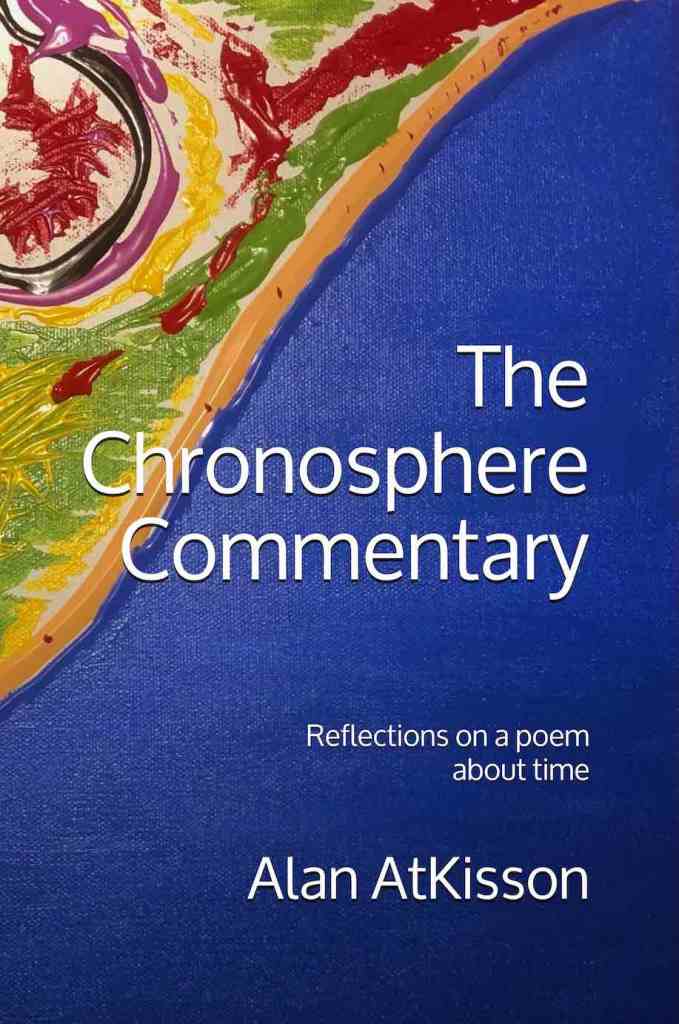
But as the book-writing progressed, the essays began wandering off, as though they had minds of their own. They began submitting to the unbreachable sense of mystery that surrounds time and death, which also colors the poetry, especially in its later verses. Sometimes an essay might help the reader unpack multiple layers of meaning in a particularly dense verse. Other times, an essay might simply lead the reader down some other path, to another question mark.
There is a meta-explanation about why I took this often non-explanatory approach to explaining my poem. As a young man, I was a great admirer of the absurdist playwrights, especially Samuel Beckett (“Waiting for Godot”) and Eugène Ionesco (“Rhinoceros “). These writers helped me make sense of the world by affirming its all-too-frequent senselessness. So when it came to weighty topics such as the ones addressed in “Chronosphere,” topics that ultimately defy explanation, mixing in absurdism seemed the only way to go.
This means, of course, that The Chronosphere Commentary — the book I published in 2020, which I am now explaining to you in 2026, which attempts to explain a poem published in 1997 — is a failure. Not just in terms of the number of books sold (which, as of this date, is less than ten). The project was doomed from the start.
After all, the explanatory power of absurdism is quite limited, or perhaps even negative, meaning that it often has the opposite of explanation’s intended effect: To settle things. To allow any question, even on a topic shrouded in impenetrable mystery, to be marked “answered”. To create the satisfying feeling that a complicated subject is now safely understood.
I doubt anyone comes away from The Chronosphere Commentary feeling satisfied or safe in their understanding. No wonder, then, that both reader and publisher interest in the book has been exceedingly limited. And no wonder, then, that I was ridiculously susceptible to a scammer pretending to be an editor who admired it, and who was seriously interested in acquiring the publishing rights to that specific book. The whole situation was absurd to the power of 3: absurd poem X absurd book X absurd AI-written scam email = absurd author response.
And yet … is it not the case that we often love our failures almost better than we do our successes? I do love The Chronosphere Commentary, to quite an unreasonable degree. So I have decided to give you (and everyone else) a free copy of the book, in digital format. You are welcome to read it now. Or maybe later. Whenever you like. (There are so many words for “when”. Which one do you like best?)
After you read the book, if you would like to acquire the publishing rights (and can verify that you are not an AI), I would be delighted to hear from you.
*
Click the button for a free review copy of “The Chronosphere Commentary”
Subscribe to Words & Music below. It’s free.