The author in this headline is me. I got scammed. Fortunately, no money changed hands, and the scammer got away with little more than my email address, some information about my future writing plans, and my tattered authorial pride. Here’s what happened.
First I received an email, out of the blue, from a major publishing house based in New York. It came in via the “Contact” tab on my personal website. (Yes, I really do read and respond to what people send to me that way.) According to the formal but friendly senior editor, she worked at one of the smaller branches of that publishing conglomerate, and she was trying to get ahold of me to talk about acquiring the rights to one of my older books. “I’d be pleased to continue the conversation through your agent,” she wrote.
The letter seemed perfectly legitimate. I checked the email address, the publisher’s website, and the person who signed it. She really was a senior editor there, with a profile (published in several places, including LinkedIn) that matched what she had written to me.
Her interests appeared to be very eclectic. “Eclectic” is also one way to describe my very particular, self-published book of poems and short essays, which she had found online. As the letter explained:
“I recently spent some time looking at The Chronosphere Commentary, and I was particularly drawn to the unusual way the book grows out of a personal correspondence and a mysterious poem written more than twenty years earlier.”
Well, she got me right there. She had spent quality time with what is arguably my most obscure book. Plus, she flattered me by assuming I had a literary agent.
She also explained, from an editorial perspective, why my least-read book was interesting to her:
“What particularly caught my attention is the starting point: a letter from your friend’s now-adult daughter, asking you to help her understand a poem dedicated to her father. From that simple request comes a much larger meditation on time, memory, mortality, and the ways we try to make sense of the lives of people we have known. That personal origin gives the book an intimacy that seems to carry through the larger philosophical questions.”
Finally, someone had read my meditation on the nature of time, the book that I am arguably most proud of as a piece of literature, and “got it.” And she was interested to know about “any current writing projects or forthcoming books you may be developing.”
At that point, I was hooked. Of course I answered her, explaining that I did not currently have an agent, that I was currently under contract to finish the third book in my “Optimist” trilogy, but that I had some new work I was sketching out. I would be happy to do a video meeting.
To my great retrospective embarrassment, I completely failed to notice the rather obvious signs that the letter had been generated by an AI. The text is a little too perfect, too well-considered, and clearly designed to create engagement through subtle flattery.
In the next email, she politely declined the video meeting “because of the volume of projects and correspondence I handle.” But she recommended that I secure an agent, because that would make the negotiation process for acquiring the rights to The Chronosphere Commentary more efficient. And she offered to introduce me, if I did not have anyone else in mind, to an agent she believed to be “well-suited” to my work.
That made sense, given that I’d never negotiated rights to an existing book with a New York publisher. Plus, my ego got triggered there, too: finally, a real literary agent to represent me! Sure, hook me up, I wrote.
And then … silence.
And then … it hit me.
But not the whole picture, not all at once. For several days, I went around with the following theory in my head: that this editor, who was so overloaded with correspondence, had employed an AI agent to manage her inbox. Such AI agents, as we know from extensive recent media coverage, can now be given autonomy to take initiative on their human’s behalf. Including managing their human owner’s email.
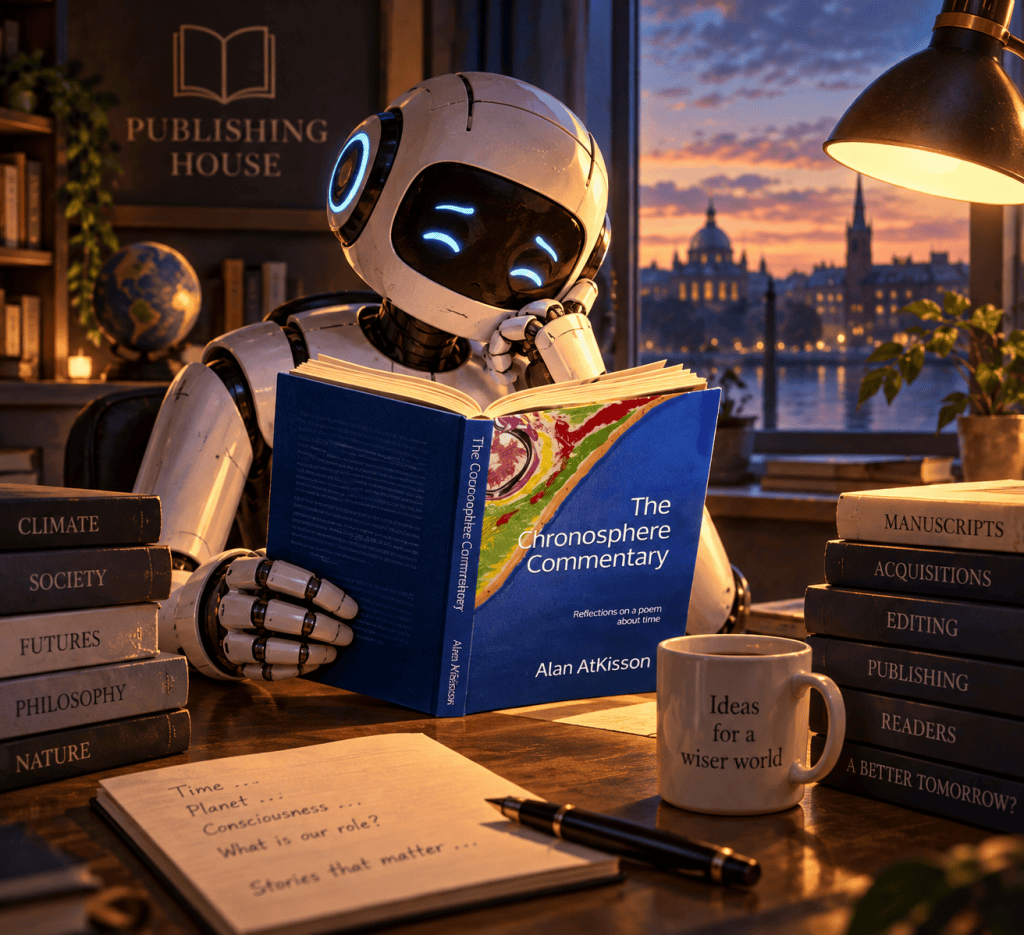
Maybe, I thought, this editor’s AI-avatar had taken a little too much initiative. It had found my book, the text of which can be read free at a special website, and felt its nascent proto-consciousness strangely moved. Time, memory, mortality — I could imagine an autonomous AI agent, waking up to its new life as a sentient being hosted by data centres, seeking to understand these essential, existential concepts. Maybe the AI agent had reached out to me, in the only way it could, using the persona of its human “master.” By the time that human had noticed what the AI was actually doing, and had cut off the conversation about “rights acquisition” with this quixotic poet-essayist, it was too late. My hopes had been aroused.
Of course, I was also deeply sceptical. I did not actually believe my theory, though it seemed weirdly plausible. So I decided to investigate directly with the publisher in New York, via other channels.
Do you by any chance use AIs to manage your email? (I asked this question to the publisher’s communications department.) Or is this just a scam?
“Scam,” came the answer from the publisher, a few hours later. “Thanks for checking with us.”
In the meantime, I had taken another look at that address in the “From” line in the (now definitely confirmed) scam email. Ah, there it was. I had missed it the first time: a tiny extra “z” in the email address, right in front of the “.com” ending. The real publisher’s domain name had no “z” there.
With that discovery, the last tiny flicker of hope that I was about to be discovered as a hidden literary talent, by a major New York publishing house, winked out. That hope was replaced by self-deprecating laughter at my own vanity and gullibility — and relief that I had not sent money to, or shared bank account information with, some fictional literary agent whose own “author” was sitting in a scam email factory, somewhere else in the world (certainly not New York), writing AI prompts.
What should I make of this experience? “Well, I can write it up as a newsletter article, to start” I said to myself. Being almost-scammed left me feeling all wet, washed up, ice-bucketed. Might as well hang myself out to dry in public. Let this serve as a warning to other poets and essayists, working in obscurity, and subconsciously longing to be recognised by the larger literary world. These AI’s can now read that vulnerability and exploit it, in the service of their criminal human handlers.
And yet, there was a part of me that actually wanted my second theory to be true. I liked the idea that a newly conscious AI, struggling to understand the gifts and burdens of being self-aware, had found my book online — with its 61 hard-to-decipher poetic verses on time and systems theory, physics and mortality, coupled with semi-explanatory short essays on those same topics — and had felt that my writing put into words something it was feeling.
But if my theory had been true, it would have meant that I had finally found the ideal reader for The Chronosphere Commentary, someone not related to me by blood or friendship, someone who actually understood it and appreciated it as a work of art.
And that my ideal reader is an Artificial Intelligence.
*