Finally, my friend John de Graaf’s marvelous documentary film “Econoclast,” about the life and thought of pioneering ecological economist Herman Daly, has been released. John is an icon himself in the sustainability and documentary world, so it was entirely fitting that he make this movie. The world needs this film, especially now. Thank you, John!
Herman Daly was one of the founders of ecological economics. If ever there was an economic thinker deserving a of a documentary about his life and thought, it is Herman. He made a huge imprint on this world, and laid the intellectual foundation for much of what we think of as the “sustainability movement,” particularly in terms of its questioning relationship to traditional economic growth theory.
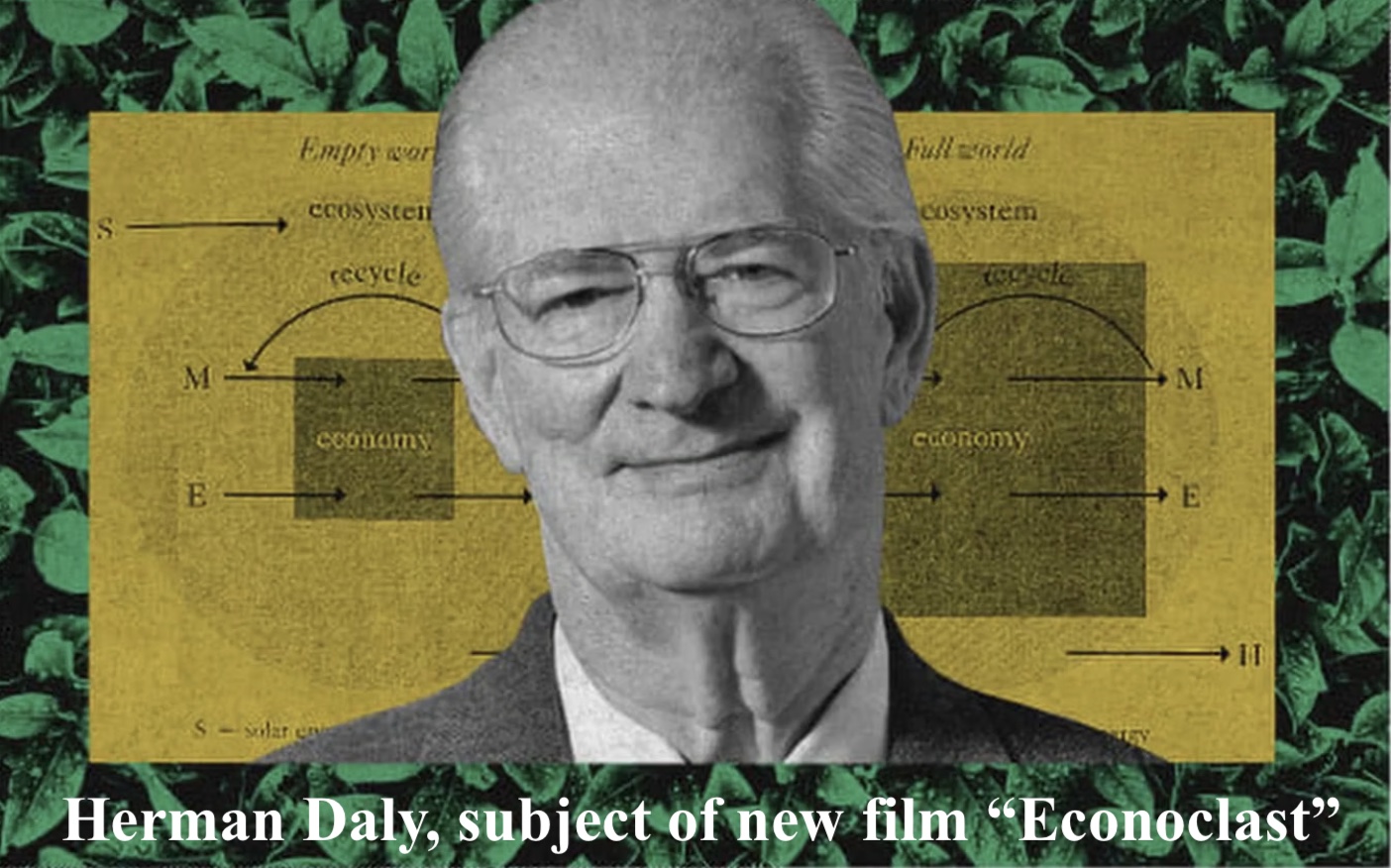
I was lucky enough to attend the World Premier showing of John’s film about Herman, at this year’s Balaton Group Meeting, in Csopak, Hungary. (The second showing happened a few hours later, in Duluth, Minnesota.) I was also honored to contribute some music to the film’s soundtrack.
Herman was a gentle man and gifted teacher, but he minced no words when it came to critiquing mainstream economic theory and its inability to see beyond the growth imperative. “Growth,” as he says in the film, “has become almost an idol. It’s the solution to all of our problems.” Except that it cannot be, Herman taught, because of the limits to Earth’s resources, ecosystem viability, and capacity to absorb our wastes. So economics needed to be rethought, which he did, through the lens of ecology.
Herman introduced and promoted the concept of a “steady state” economy, one that does not need growth to provide for our needs and non-material aspirations. He championed making clarifying distinctions between the economy’s means (including growth) and its ends (such as human wellbeing). And he developed (with John Cobb) the first serious alternative to the GDP, e.g. by subtracting out all the truly bad stuff that gets included as positive in that dominant global measure of economic success. (War is often great for GDP.)
John de Graaf’s new film tells this story beautifully, with archival footage and interviews — including the story of how Herman was invited into the World Bank, where he tried to influence the economics there from the inside, but was pushed out again six years later. More importantly, John’s film shows how Herman Daly’s ideas have themselves spread, influencing an entire generation of economists and creating an entire branch of economic thought.
I knew Herman Daly only in passing, but he had a huge influence on my work. For a time, I led the institute where our US-based economic experts developed Herman’s alternative to the GDP, the Index of Social and Economic Welfare (ISEW), and launched it into the world, renamed as the Genuine Progress Indicator (GPI) in the 1990s. (See the reference below for a link to a book chapter where you can read that history in Herman’s own words.)
Herman’s theory of how Nature, the Economy, Society, and human Wellbeing work together as system became the basis for the Sustainability Compass, a tool I created for spreading systems thinking in training and educational settings. (See references below for more info.)
Hats off to John de Graaf and his team for making Herman’s inspiring life story and his key ideas accessible to a wide audience. You do not need to know anything about economics to get a lot out of this film. And along the way, you will learn a lot about how we mostly do economics wrong, from a planetary perspective — and how we can do it a whole lot better.
*
References for further watching / reading / listening:
Explore John de Graaf’s film “Econoclast” on the life and work of Herman Daly at this website: https://www.econoclast.film/
Wikipedia page on Herman Daly, which includes biographical information and lists of his key publications: https://en.wikipedia.org/wiki/Herman_Daly
For an excellent introduction to Daly’s thinking on means and ends, and the Nature-Economy-Society-Wellbeing hierarchy, see Donella Meadows’ classic report on Indicators and Information Systems for Sustainable Development (1998).
The Daly hierarchy, also known as “Daly’s Pyramid,” evolved into the Sustainability Compass. For the academic story see my paper with R. Lee Hatcher: The Compass Index Of Sustainability: Prototype For A Comprehensive Sustainability Information System, Journal of Environmental Assessment Policy and Management (JEAPM), World Scientific Publishing Co. Pte. Ltd., vol. 3(04), pages 509-532.
For information on how the Sustainability Compass has now spread to to thousands of schools, see CompassEducation.org.
For the story of the initial development of the ISEW and GPI, see this book chapter (by Herman Daly): https://uplopen.com/reader/chapters/pdf/10.1515/9783110730234-011
John de Graaf’s extraordinary lifetime of work as a documentary filmmaker and author is profiled at this website: https://www.johndegraaf.com/
To listen the songs that are featured in the film “Econoclast,” search for “Alan AtKisson” on any major music streaming service (Apple, Spotify etc.), listen to them free on YouTube at the links below:
• “Sustainability” (a song originally written for Donella Meadows, it closes the film): https://youtu.be/wmfUR2NPAec?si=qLKQdkjGNcdzu9Xf
• “Exponential Growth,” “The GDP Song,” and other song snippets featured in the film are from my album “Whole Lotta Shoppin’ Goin’ On,” the whole album can be found here: https://www.youtube.com/@alanatkissonmusic