Dear Dana,
I know you are dead, but I thought I would write to you anyway. Because, well, you never know.
The 44th meeting of the Balaton Group, that network of sustainability researchers and systems thinkers that you and Dennis Meadows founded back in 1982, is coming to a close. I believe you would have been very pleased with it. In fact, I know you would.
As you recall, assuming you are somewhere out there in the Universe, these annual meetings are very hard to summarize. Citing their formal topics never does them justice. They are more like giant social experiments (you were a scientist after all), where people from dozens of disciplines, countries, and cultures, ranging from brilliant 20- or 30-somethings to persons with substantially more tree rings to count, all come together to explore the edges of a hot topic. The results are unpredictable. Except that they are always wonderful.
So, the topic this year was Climate Change and Disaster Risk Reduction. “Again,” I should add, because this was Year 2 of a two-year meeting series. (I missed Year 1, which was in Japan, and many recent years for work-related reasons, but I was very happy to be back this year.) You see, back in the 1990s, when you were still alive and we sometimes worked together, the idea that there might be climate change disasters to manage in the future was still mostly theoretical, even controversial.
Unfortunately, now it is neither.
Except, of course, to certain political leaders who like to throw pixie dust in people’s eyes, hypnotize them with repetitive chanting, and tell them to ignore the evidence of science. This is the same science, mind you, that makes their fancy new telephones work, which unfortunately also enable their iniquitous behaviour. (By the way, you would not believe what a telephone can do these days.)
The presentations at this Balaton Group Meeting were uniformly excellent. And scary. And really stimulating. And sometimes hopeful and inspiring. And scary. Did I say that already?
My guess is that you have no need of data where you are. But the data on things like heat waves, droughts, floods, the strength of El Niño events, melting ice, and all those things we were pretty worried about, before your sudden departure to points unknown in 2001, was pretty stark. Everybody at this meeting was using words like “cascading” and “compound”, but they were not talking about cascading waterfalls or the compound interest in their savings accounts. They were talking about risks and disasters: how one climate change related event can trigger a second one, and a third, in a growing cascade. These things can also get piled up and compounded together in a messy jumble, either as risks or as real, horrible events. Suddenly, melting ice on a mountain undermines soil, which leads to a massive collapse of rock and ice into a river, which then rams a wall of water into a community, which was built too close to the river, etc. etc. etc.
“Risks” turn into destruction, mayhem and misery.
That’s just one example. Various versions of that story, with different main characters but similar-sounding plots, are getting repeated with greater frequency and stronger intensity. As the novelist Kurt Vonnegut might say, when he was describing the once-avoidable but now-ineluctable outworking of tragic logic leading to depressing results (I remember that you liked his books), “And so it goes.”
And goes.
And (sigh) goes.
Given that so it has been going, the Balaton Group — which usually works on sustainability, solutions, positive futures, etc. — apparently decided it was time to stare this issue of disasters right in the face. Avoiding, in any meaningful sense, an encounter with the “coming catastrophes” caused by climate change is no longer an option. The world has to adapt, while still working to stop the processes that fuel global warming, the all-too-quantifiable phenomenon that is now forcing us to adapt. We have to try to minimize loss of life, damage, and disruption in the face of the inevitable.
So given those “have to” statements above, what did the meeting accomplish? Besides giving those who attended it a chance to rest for minute in between teaching assignments or policy reports or institutional leadership meetings or fundraising efforts (that’s especially tough right now) and learn new stuff. Or get stimulated by the latest ideas from France, where they are always producing fascinating concepts (like “robustness”). Or by the community-level processes to address the countless “mini-disasters,” such as smaller-scale floods that prevent lower-income kids from even going to school. Or by the big-picture efforts to get the risk of climate change disaster considered more seriously as a security issue by national governments — among a dozen other topics.
Or by dancing to Hungarian folk music, which the latest version of the Balaton Group still does, just like we used to do in what I increasingly refer to as “the old days.”
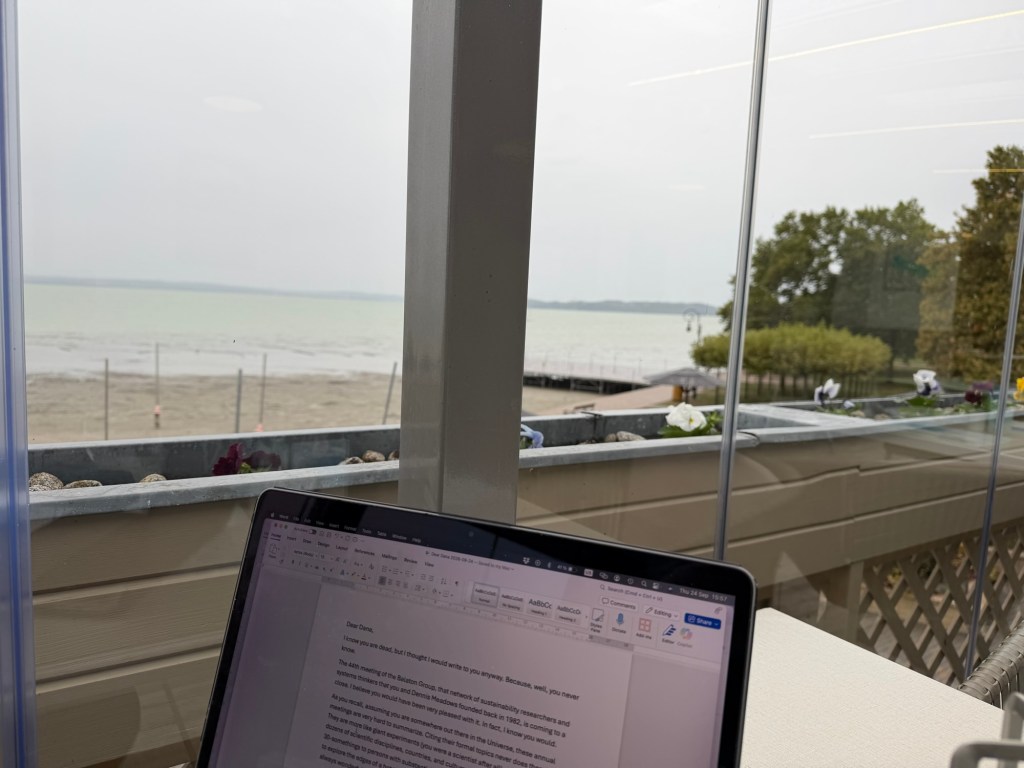
I forgot to mention that this meeting was held at the same Hungarian hotel where the Balaton Group was founded, in the tiny lakeside town of Csopak, at the former Hotel Petrol, so named because it was owned by the Hungarian Oil and Gas Ministry back then. This is where I first came to a Balaton Group Meeting in 1992, at your irresistible invitation. And now, after years away from Csopak, the Balaton Group Meeting came back to these Lake Balaton roots. That is why I used the metaphor of tree rings above, when referring to older folks like me. Remember that little tree that you and Dennis and others planted back in 1987? It is now a mighty fir, nearly five stories tall, way too big to wrap your arms around. That should definitely make you happy, for reasons both real and symbolic.
Anyway, Dana, you can guess the answer to my question above, about what the meeting “accomplished.” Mostly, it did not accomplish anything. It will not publish formal “proceedings” or “papers”. That is not the point. That is not what you and Dennis designed these meetings to do, and we are still following your basic design, 44 years later: Come together. Make friends. Learn things, in a respectful interdisciplinary environment. And then help each other succeed, back out there in the world, which still needs all the systems thinking it can get.
What the point of the Balaton Group Meeting actually is, as you hopefully still remember, is what I can already see all around me, even before we have enjoyed our traditional, unpredictable final banquet. (Those banquets are as seriously playful as ever, you will be glad to know. Lots of crazy stuff happens.) There are multiple signs of people leaving this meeting with a kind of inner compulsion do try something new, or try something a bit different, in their various professional contexts. Maybe raise awareness of Disaster Risk Reduction generally (because, I am sorry to tell you, the world is still sleepwalking). Maybe try to bake some of the newest approaches into the DRR or sustainability projects they are already doing. Maybe start a new summer school. Maybe write a provocative paper that brings ministries together who do not usually talk to each other, so that surviving climate change is not sabotaged by silo-thinking or polarized politics. That sort of thing.
Or maybe just go home re-energized to keep on keeping on, doing what they feel really needs to get done to advance sustainability, resilience, robustness, a livable world, maybe even the idea of a living Earth. (I confess the last one is my own current fascination. I will write you about that later.)
I am sure you remember how it was. It always happened this way, and it still does. The Balaton Group’s narrative has the opposite valence of Vonnegut’s “And so it goes.” Most of the members believe that the world does not have to go this way. It can go differently. And the members of this Group, new and old, in attendance at this year’s meeting or working in their home contexts, are all still using every skill they have to intervene in the terrible, depressing logic of “And so it goes.”
So it should definitely not go, they all seem to think to themselves.
(Weird fact: the song playing at this little café by Lake Balaton, where I am writing these very sentences, right now, is Swedish House Mafia’s “Save the World.” I am almost ready to entertain the notion that you had a hand in rearranging the playlist.)
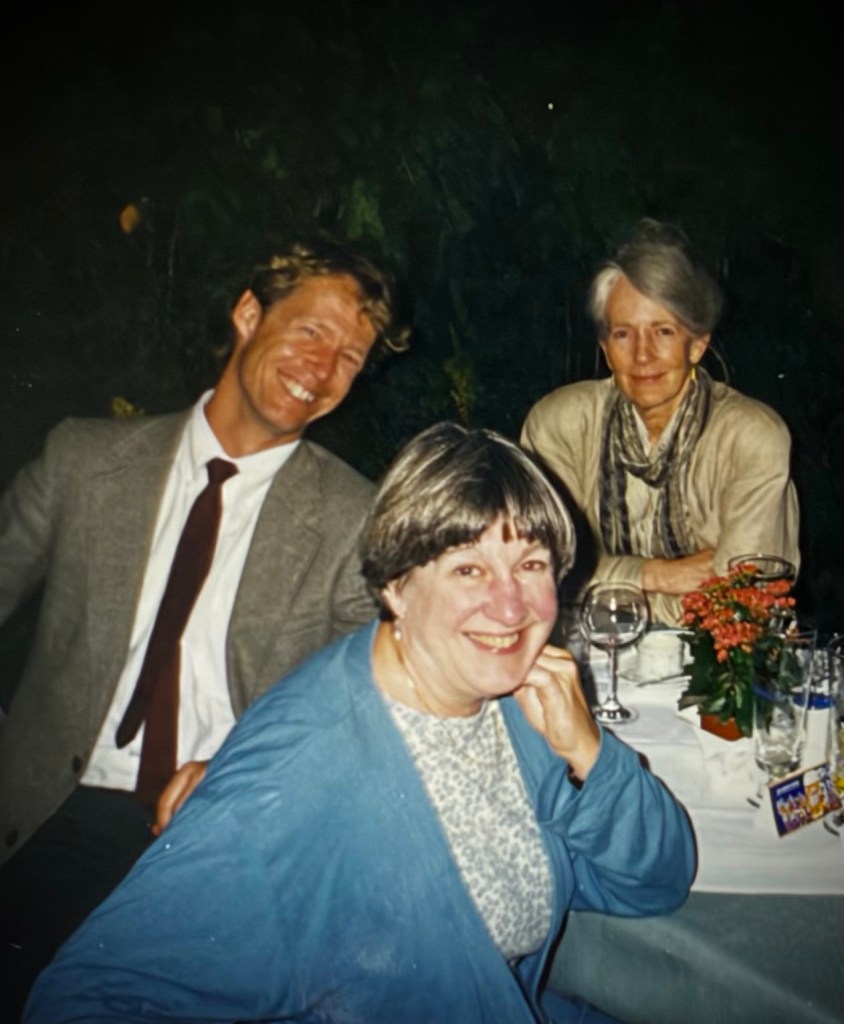
Anyway, we miss you, dear Dana. Dead or not, you and others (like our dear friend Joan Davis, who did so much to ensure that this Group had both a vital collective spirit and enough resources to keep acting in this world) are very much alive to us.
More importantly, we are alive to each other. Alive to face this moment. With friends and colleagues, here, and everywhere. My strong belief is that there are many, many more “Balatonians” — people who care deeply about working to change that pessimistic “And so it goes” to “This is how it can go, let’s try” — than any Balaton Group Meeting could ever accommodate.
That belief, like so many other things, is something I got from you.
Take care out there,
Love,
Alan