Remember the 17 Sustainable Development Goals? The SDGs, also known as the Global Goals? I do not mean to imply that the SDGs have been forgotten. In fact, Internet search data tells us that interest in the SDGs has steadily and continuously grown since they were first adopted in 2015. But we need to remember the SDGs more often, and think hard about them, because their future — and our World’s future, and Nature’s future — is at stake.
Lately I hear colleagues talking about “SDG fatigue,” and I see evidence that this is a real phenomenon. The Forus “network of networks” for NGOs is a good indicator because it reflects the input of civil society organisations around the world. In late 2025, Forus said their members were “raising urgent concerns about the growing ‘invisibility’ of the Sustainable Development Goals in political discourse.”
I understand why they are worried. The United States Government has famously said that it “rejects and denounces” the SDGs and the whole 2030 Agenda, declaring it “inconsistent with U.S. sovereignty.” Argentina has withdrawn from the voluntary SDG national reporting process. Even Norway’s national SDG stakeholder roundtable, which should meet three times per year with five different ministers, only managed one such meeting in the years 2024 and 2025. Considering that Norway’s former prime minister Gro Harlem Brundtland led the UN commission that formally introduced “sustainable development” to the World, back in 1987, this indicator of “SDG fatigue” is tinged with irony.
Investigating the troubling lull in “SDG energy” prompted me to do two things: look back, and look forward. For the book I am writing, I revisited those heady times leading up to the adoption of the UN’s 2030 Agenda, also called “Transforming our World.” Ah, those were the days. To me, the list of 17 Goals agreed to as part of the global Agenda remains an inspiring read all by itself. The SDGs call for eliminating poverty and hunger, providing education for all, ensuring equality for women and girls, protecting our planet’s climate and biodiversity, and much more.
When the whole World signed on to those goals, I was so happy that I started an international voluntary initiative called “17Goals” to help the UN spread the word. We had a website where we published free educational materials, which were downloaded thousands of times, and I created an SDG song, complete with a music video. (The 17Goals website was later hacked and is still offline, but you can see the music video on YouTube, and listen to my global dance song “We Love the SDGs” on any streaming service.)
But that’s just nostalgia. Let’s look forward.
We are approaching a kind of deadline, and a recent UN assessment confirms the obvious: thanks to a pandemic, wars, a few unenthusiastic (to the say the least) governments and other challenges, we will not achieve the SDGs by 2030.
So, what happens after 2030? Here is the most optimistic answer I can offer, after spending hours combing through recent UN reports and meeting transcripts, as well as other sources:
Nobody knows.
This answer is optimistic because it means that all possibilities regarding the SDGs are still on the table. Nothing is pre-decided. In 2027, the negotiations about what happens after 2030 begin in earnest. By then, there will also be a new UN Secretary-General, with his or her own agenda. Also by then, the world will no doubt have changed dramatically — again. But how it will change, we cannot know. With the rise AI, wars and tensions in geopolitics, increasing climate trouble, and a jittery financial system all looking like jokers in a loaded deck, we just have to wait and see which cards we are dealt.
Which leads me to a recommendation, which I now make to anyone and everyone seriously interested in that question of what happens with the SDGs post-2030.
Read this report:
Beyond 2030: A Transformation Architecture for Delivering Sustainable Development, by Stuart Davies and Kishan Khoday, No 58 UNDP LAC PDS, September 2026
I have include those fancy identifiers — this is number 58, in a Policy Document Series, produced by the United Nations Development Program, at its regional office for Latin America and the Caribbean — because they underscore that you will probably not bump into this publication unless you are deep inside the UN machinery. Or possibly if you are working with the Jamaican government, since that is where this regional UNDP office is located. But this excellent report deserves a much broader readership. If its message is taken seriously by the negotiators, officials, technical experts, and other stakeholders who will soon be immersed in that “what-happens-after-2030” dialogue, it just might save the whole SDG enterprise. And that would be very good for the World.
The paper’s authors, Stuart Davies and Kishan Khoday, are this UNDP office’s Senior Economist and its top official (known in UN parlance as the Regional Representative). Their paper came to my attention thanks to an AI research assistant, which recommended it to me based on what it knows about my interests. And one of my keen interests is trying to secure a better future for sustainable development.
Some version of the SDGs will likely be extended past 2030, and I want those 17 Global Goals to stand a chance of being realized in my lifetime. To be honest, 2030 was never a realistic deadline for the SDGs, even in the best of circumstances. And we clearly have not been enjoying the best of circumstances — which is why we need a new approach.
Although this report was issued by a regional UN office, it is the best thing I have read so far on the global topic of “what happens after 2030.” It nails many of the key questions that must be answered by the negotiating process, and it offers a number of sensible answers as well. Most importantly, it shifts our attention to an approach that might actually work.
Davies and Khoday argue that the “post-2030 discourse” — meaning the coming three years of meetings and negotiations — should not focus on revising the goals, but on the “transformation architecture” for achieving them. The authors are very clear about what that means: Clear mandates. Budgets. Delivery systems. Accountability mechanisms. I realize that in the current international political climate, words like these (even just the word “budget”) may seem as idealistic and dreamlike as the SDGs themselves. But the authors have done their research. They have plowed through the recent literature. They have looked at the numbers. Their case is convincing.
We do not need to rethink what to do, say these authors. Spending three years talking about a new set of goals is likely to be a waste of time. (That last phrase was me talking, not them.) We know what needs doing. Instead, we need to redesign how to get it done.
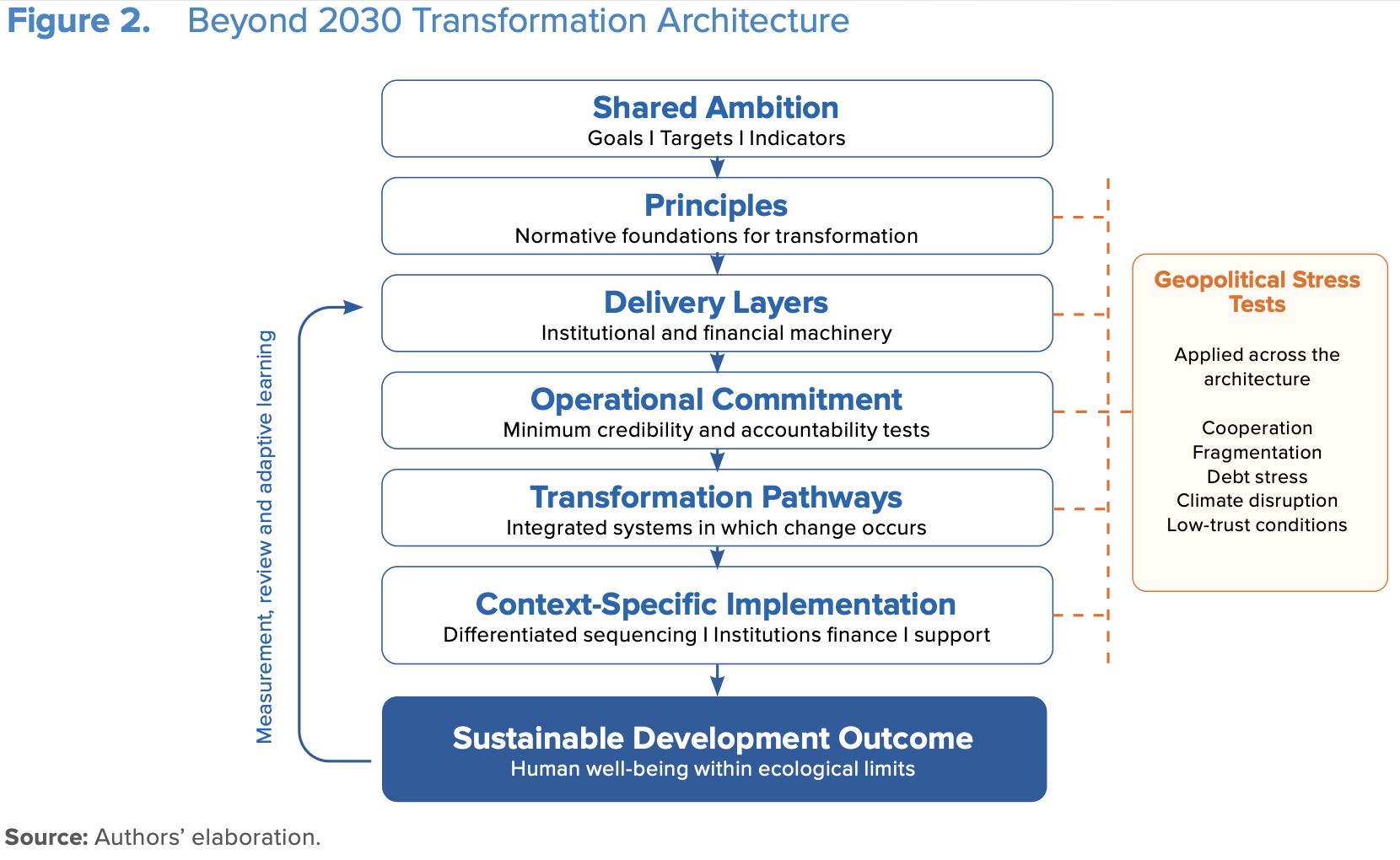
A picture is worth 1,000 words and sometimes, so is a diagram. Davies and Khoday’s diagram is not TikTok-ready, but it neatly summarizes their proposal. It will give you a general idea of what they mean by “transformation architecture,” but again, I recommend that you download and read their whole report. (It is only 15,000 words, which is relatively compact, equal to about 1.5 chapters in a book. Plus another 4,000 words for the References.) Or at least read the Key Messages. (Just 209 words.)
Here is the diagram:
Three things I want to lift up here:
- Notice the pragmatism. The SDG system of Goals, Targets, and Indicators is still solidly in place (with or without revision). That is the World’s “Shared Ambition,” at the top. The UNDP report acknowledges, as many do, the massive achievement of establishing the SDGs as a “universal language” for that global ambition. But for the period after 2030, we need an “Operational Commitment” rising to the level of genuine credibility and accountability. We also need a steady focus on making real change, in the systems that actually matter (i.e., the “Transformation Pathways”).
- Notice the explicit integration of this phrase: “within ecological limits.” This is another example of the hard-core realism that makes this report so noteworthy. The SDGs were weak on this essential point: that we must pursue development within the non-negotiable limits of the Earth’s physical and living systems. The new transformational architecture needs to reflect that tough but inescapable reality: “Treat planetary boundaries and critical natural capital as binding conditions for planning, investment and measurement, while making ecological restoration an explicit objective.” Hear hear!
- Notice the box to the right: “Geopolitical Stress Tests.” This is a bold idea, and it is hugely important. A new (or strengthened) focus on dramatically improving implementation needs to include such stress tests from the get-go. Whatever is agreed to globally for post-2030, and whatever each individual member state decides to do at the country level, must have some real robustness built into it. These strategies and plans must have a solid chance of surviving the various pressures (climate-related disasters, financial crises, etc.) that will undoubtedly get thrown at them by an unstable, unpredictable world.
In its final pages, the report applies all this thinking to the real case of Jamaica, where the authors live and work. It seems clear that the situation of Jamaica, which is representative of both vulnerable nations generally and island states specifically, was also an inspiration for this proposed way forward. “For Jamaica,” note the authors after showing how this framework could work for that country, “Beyond 2030 should be less about negotiating a revised list of goals and more about creating the conditions for effective sustainable development.”
I sincerely hope that this crisp, thoughtful paper gets a wide, global reading by all those involved in thinking through the post-2030 process and the future of the SDGs. The report provides, at the very least, an excellent starting point for the inevitably complex process of deliberating among nations. And it closes with a very clear summary of the conditions for success:
This paper does not prescribe a final list of post-2030 goals or resolve the political choices that future negotiations will entail. Instead, it identifies the minimum conditions needed to make a successor framework credible and operational. Any new framework should be judged by whether commitments are financed, responsibilities are assigned, implementation is supported, results are independently assessed, and shortcomings lead to corrective action. The opportunity of Beyond 2030 is not to produce another catalogue of aspirations, but to convert shared global ambition into an accountable and adaptable compact for improving human well-being within ecological limits. (p. 36, emphasis added)
This is an authorial voice both diplomatically humble and pragmatically ambitious — which is exactly what we will need more of in the coming years. And in all likelihood, for a long time after that.
*
Alan AtKisson served as a senior independent consultant to the United Nations from 2009 to 2017, working with a number of UN programs and offices on strategic planning, knowledge management, and international meeting facilitation. He also assisted the UN Secretariat (Department of Economic and Social Affairs, UNDESA) in various aspects of planning for the initial implementation of the Sustainable Development Goals, including work with the first pilot countries to integrate the SDGs into national development planning, and the initial design and launch of the UN Office for Sustainable Development, based in the Republic of Korea. He is a former Assistant Director-General and Department Director at Sida, the Swedish International Development Cooperation Agency, where he led Sweden’s global funding programs on development research, civil society strengthening, capacity development, private sector cooperation, and innovative financial instruments such as guarantees, from 2018 to 2024. He lives in Stockholm.
No AI was used in the writing of this article. AI services were used for conducting document research, and for creating social media imagery.
Sources:
UNDESA, “The Seventeen Goals” (UN Website)
Ricardo A. Correia and Enrico Di Minin, “Tracking worldwide interest in sustainable development goals using culturomics,” PLOS Sustainability and Transformation, 30 June 2023
“In the Next Five years: Breaking the SDG Bubble,” Forus, 14 Nov 2025
“U.S. rejects 2030 UN goals on ending poverty, tackling climate change,” Associated Press (via Global News), 7 March 2025
“Brundtland Commission,” Wikipedia, accessed 28 Oct 2026
“Transforming our World: The 2030 Agenda for Sustainable Development,” United Nations, 2015
“We Love the SDGs,” music video by Alan AtKisson, produced by Bente Milton, 2015
“The Sustainable Development Goals Report 2026,” UNDESA
Stuart Davies and Kishan Khoday, “Beyond 2030: A Transformation Architecture for Delivering Sustainable Development,” UNDP LAC PDS N°58, September 2026

