How much do you know about what it’s like to be a writer in Ukraine? Nothing? Then you are like me — before last night.
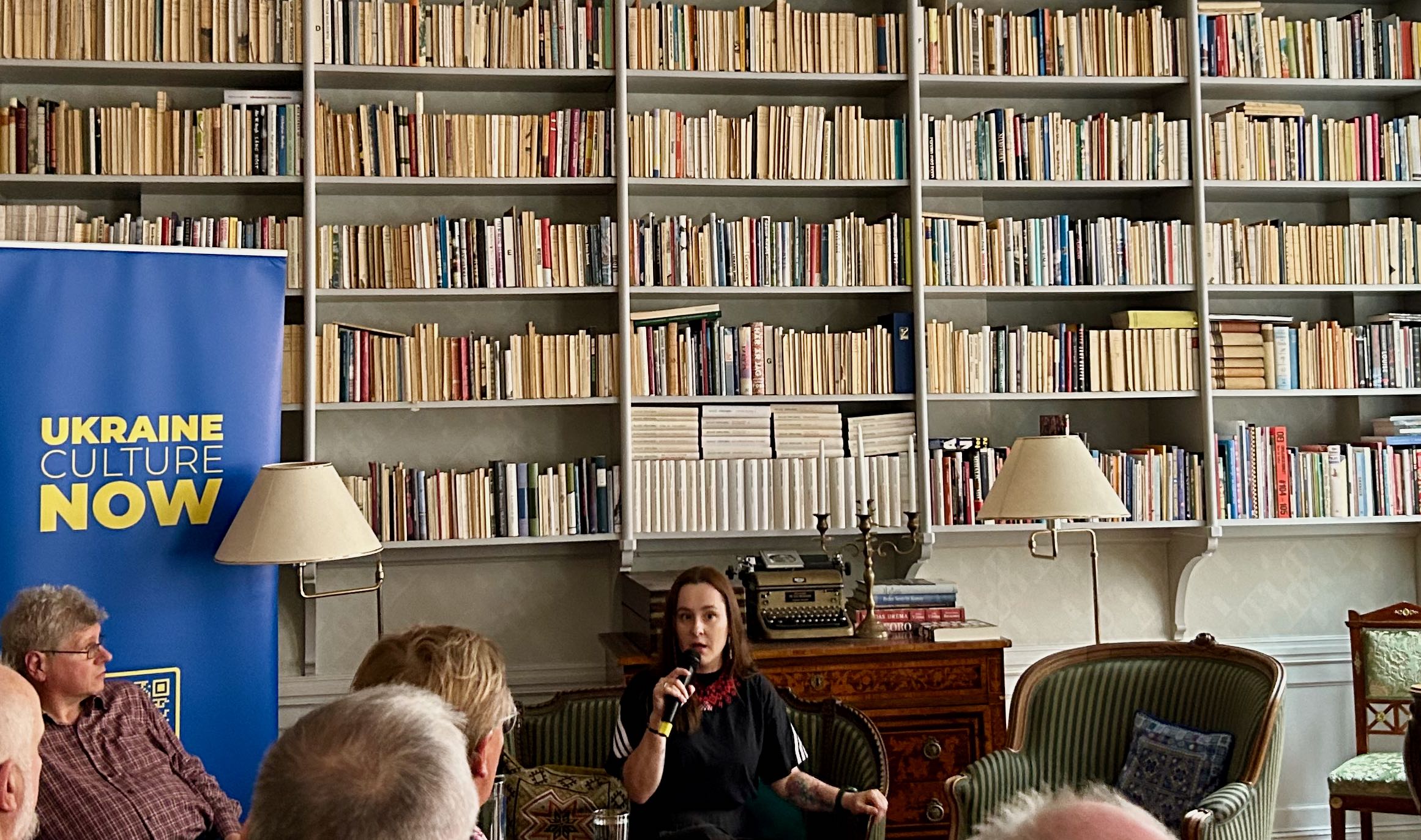
Recently, I became a member of the Swedish Writers’ Union (SWU), and I immediately began receiving emails to interesting events, including an invitation to a talk and mingle with Ukrainian playwright and author Alina Sarnatska: “Meet her in a conversation about different people’s situations and reactions to the war in Ukraine,” said the understated email. I had never heard of Alina Sarnatska. To my embarrassment, I realized I knew nothing about contemporary Ukrainian cultural life, other than the miracle of its continued existence. So I went, to listen and to learn.
I am so glad I did.
What follows is a report from that event, quoting extensively (with her permission) from Alina Sarnatska’s responses to questions posed to her by moderator Henrik Brändén, and from the audience of about thirty people. Note that I have not actually read any of Sarnatska’s literary work. Nor have I consulted any other published articles or reviews. Everything you read below I learned “from scratch,” directly from Alina Sarnatska herself, yesterday evening. (Any errors in reporting are my responsibility.)
Let’s start with the very last question posed to Alina Sarnatska, since I was the one who posed it. It helps to introduce the topic, but it was the least important question of the evening.
How does one survive economically as a writer in Ukraine?
Perhaps five to ten authors can make an actual living from their work in Ukraine. Half a year of work and successful book will net you about 500 Euros. Serious authors must cobble together a mixture of small grants, prizes, artistic residencies in other countries — and in the case of Alina Sarnatska, a day job, working for a women’s NGO.
Sarnatska has also recently become Dr. Sarnatska, having just completed a PhD in social work that she started before the outbreak of the war. But it was in her role as author and playwright that she was visiting Sweden, on one of those aforementioned writers’ residencies, which the SWU provides.
And please bear in mind, as you read the rest of this report, that Alina Sarnatska is one of Ukraine’s finest playwrights. She has won all three of the major prizes for theatre-writing available in her country, as well as an award for her latest novel and several other prizes and fellowships internationally. Her work has been translated and staged in several countries, including Sweden’s Royal Dramatic Theatre.
But in the reality that is wartime Ukraine, she cannot live economically on her art. Fortunately, she has that day job, and very understanding co-workers who support the fact that she also writes. While she was still serving in the army and taking part in heavy fighting, her colleagues renovated the office. They also bought her a desk and a chair and sent her photos, telling Sarnatska that her workplace was waiting for her when she came back.
Recounting that story brought a small tear to Alina Sarnatska’s eyes.
Why do you write?
Sarnatska had a way of pausing and looking down, just briefly, to collect her thoughts before beginning her answers in English. As each answer came, it felt well considered, without feeling rehearsed. This gave her explanations a quiet sense of authenticity and power.
She writes, she said, because she swore to herself — in the midst of active Russian shelling — that if she lived through her military tour of duty as a medic on the Ukrainian front line, she would write about it. “I will write if I survive.”
And there was much to write about. Sarnatska told us that she had learned to write, had tried to write, prior to the war. “But I was afraid to write.” Serving in the war, and surviving, helped her to overcome that fear. Now she has written nine plays and two books in a very short time. Much of her work draws on what she experienced in the Ukrainian Army.
Why did you join the Army?
“Why did I join the Army?” Pause. “Because the Russians tried to kill everyone in my city.”
Alina Sarnatska was a witness to the aftermath of the Bucha massacre. If you walk into a city and you see a body lying on the street, she told us, it is not so scary. “A body on the street looks like autumn leaves or something.”
But then she walked into the church. She saw something that looked like a large pile of garbage, which struck her as very odd. She looked more closely. She realised that she was looking at the the bodies of the dead. They had been gathered and placed there.
“Seeing something like that — it can change anyone.”
What is it like to be a woman in the Ukrainian Army?
“Complicated.” Younger people in Ukraine tend to be more feminist, but the older generation can regard women serving in the army as somehow shameful. They might even make a nasty comment when passing you on the street. But that did not stop Sarnatska (and many other women) from volunteering.
As a woman, Sarnatska, who has no medical background, was immediately put into the job of nurse. After minimal training, she was sent to the front line, part of a “civil defense battalion,” equivalent to being infantry. They had minimal equipment, and she faced many medical problems for which she was unprepared but that she was expected to solve. After putting out a plea for help on Facebook, she found a doctor in Lviv, a woman working as a gynecologist, who was willing to support her with advice and instruction. “She was there for me, 24/7”, said Sarnatska, helping her treat everything from war wounds to the high blood pressure experienced by her older colleagues in the civil defense.
Why do you write about the LGBTQ experience in the Ukrainian Army?
“Our war is the most documented war in history from an LGBTQ perspective,” she told us. Many openly LGBTQ people serving in the military are very visible in social media. “So you can’t pretend they don’t exist.”
But social media is short-lived, while a book “is for a hundred years or something.” Polling data in Ukraine today indicates a generally positive view of LGBTQ issues, with more than half of respondents even indicating that they support gay marriage. But the government “doesn’t dare take the risk.” And one never knows: “In the future there could come a rightward shift.” So Sarnatska has documented the reality of the LGBTQ military experience in her own work, for posterity.
Why are Ukrainians still fighting? What sustains their willingness to fight?
“Finally, an easy question,” said Sarnatska, who also had a quick answer. “We don’t want to die. They [the Russian invaders] showed us that they will kill all of us. That is why people are still fighting. We do not have a choice.”
In a similar way, Sarnatska noted that her writing can also be seen as part of the war effort. “All culture during war is propaganda,” she explained. This occurs by default. Whatever you write can be used for good or bad purposes, by one side or the other. That is the reality, and “you can’t be out of it.”
But that does not stop her from writing what she wants to write. “I have an artist inside of me,” she said. “I cannot say to that artist, do this, don’t do that.” Being a writer in wartime comes with certain responsibilities, but “you should still be human.”
Being human — how we fight, how we get along, how we survive — appears to be one of her main themes, and her new book “C.K.A.M.” (not yet translated) also takes up the LGBTQ experience on the front line. Despite that potentially controversial focus, after the book’s publication in Ukraine this year, “I received no hate,” she happily reported. Sarnatska saw that as an indicator of progressive attitudes in her country.
Not that LGBTQ people are universally accepted, in Ukraine generally or in the military. “But injured people never say, ‘Stop the ambulance, let me out, because you are gay!’” Especially on the frontlines, “you become a family.” You still fight with each other, as families do, perhaps even bitterly. But you hold together as a family despite your differences. “You still say, please pass the bread.”
Do you ever think about what you would like to write about, after the war is over?
This question generated a somewhat longer pause. “I am not sure we will ever see the end of the war,” said Alina Sarnatska. “Maybe it will end in 2060, and I will be too old to write.” She explained that Ukrainians do not have the luxury of thinking about when the war might end.
“We have a war right now. That’s all I know.”
*
If you want to read more about Alina Sarnatska’s work, below are some websites and articles in English that I found after listening to her evening talk at the Swedish Writer’s Union, on 9 June 2026. The event was co-organised by a non-profit group operating in Sweden called Ukraine Culture Now, which promotes engagement with Ukrainian culture generally and specifically in Sweden (the website is in English). I just joined that organization myself.
Alina Sarnatska’s website in English, including descriptions of her plays and book:
“‘I need to do everything now’: the Ukrainian combat medic-turned playwright,” article by Charlotte Higgins in The Guardian, 16 Oct 2025:
https://www.theguardian.com/stage/2025/oct/16/alina-sarnatska-ukrainian-combat-medic-playwright
Information about an event in Los Angeles, in May 2026, where one of Alina Sarnatska’s plays was staged as a dramatic reading, with the roles performed by US military veterans:
Please like, subscribe and share
Also published on Substack

