In Yoko Ogawa’s haunting novel The Memory Police, ordinary things — whole categories of things, such as birds, hats, and boats — begin to disappear from an island community. The few people who try to preserve those things, and who still have the capacity to remember them, are rounded up and interred. Most people, however, simply get on with life. They never even mention the disappeared items, and they are mentally unable to feel the weight of their loss.
Foreign aid, development assistance, ODA funding — all of which refer to the transfer of money from wealthy countries to developing countries, which I will just call “aid” for the rest of this article — appears to be suffering the same fate.
In 2025, aid experienced the largest single-year decline in global history, over 23%. At first, these gigantic reductions generated equally huge headlines, assisted by dramatic pronouncements, such as Elon Musk writing on social media that “We spent the weekend feeding USAID into the wood chipper.” Today, USAID, the United States Agency for International Development, no longer exists. It has quickly been forgotten. The USAID.gov website is still live, but it has nothing but the original “Notification of Administrative Leave” that abruptly informed agency employees that they were out of a job on February 23, 2025. “Additional guidance is forthcoming,” the website promises. Nothing else was ever published there.
But USAID’s demise did not account for the full decline in 2025. Aid budgets dropped like stones in other countries as well.
And since then, the whole topic of aid seems to have nearly disappeared from the arena of global public discourse.
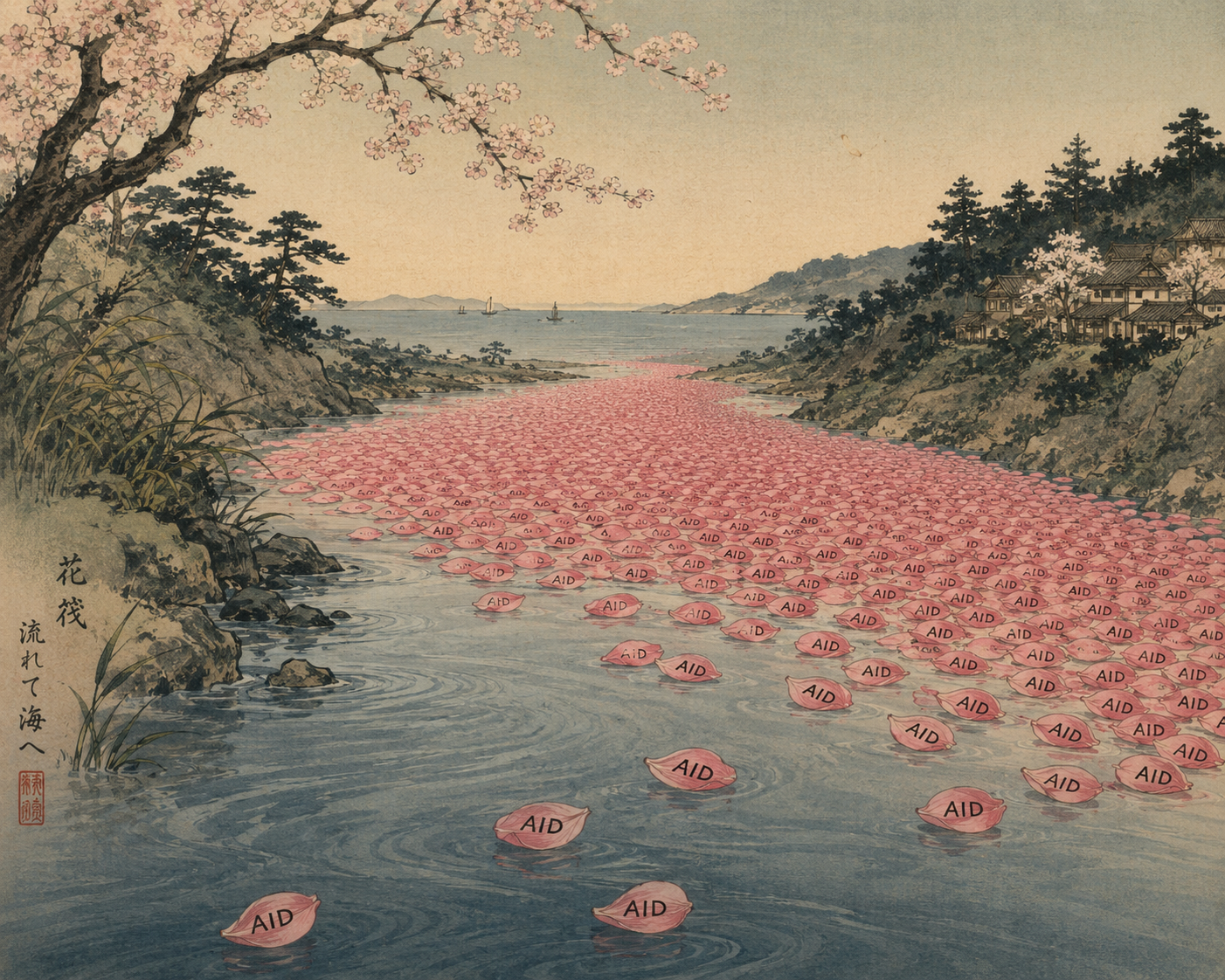
Of course, news about what is happening to aid, what that means, and what should be done about it, is not completely gone, as roses are suddenly gone one day in Ogawa’s novel. (I cannot get this image out of my head: a thick carpet of flower petals, floating away down the river, and then disappearing forever.) But information about aid is getting harder to find, and very few global news agencies are talking about it.
I was nudged into this realization after reading a newly completed Masters thesis. Months ago, Sydney Wilhelmy, a student at Berlin’s Hertie School, approached me for an interview after reading my article The Tragedy of Swedish Development Aid. I obliged. His topic interested me: what was actually happening to Swedish and German aid budgets? Both were experiencing cuts, but why? How did the processes compare? Were the choices principally driven by political or budgetary concerns? Wilhelmy wanted to look at such questions objectively for his thesis, and he spoke with knowledgeable people from inside and outside the aid agencies involved, in both countries.
Some of his findings, which I summarize below, reawakened me to asking questions about aid, after a long summer nap. With my own career in the field declared complete, my article on Swedish aid (including the light social-media buzz around it) solidly in the rear view mirror, and that Masters-thesis interview concluded, I — like a character in Ogawa’s novel — pretty much stopped thinking about aid. Plus, I was distracted by trying to write a book on another topic. (In Ogawa’s novel, the same is true of the main character, also an author.)
But while I had forgotten, Wilhelmy had not. He kept his promise and sent me a copy of his final paper. It was quite a good thesis. Reading it got me thinking again and performing some Internet searches of my own, to get updated on the overall topic of aid.
After half an hour of searching the Internet for news articles, I had learned … relatively little.
There was the OECD data on aid’s massive decline, already cited above, which was published in April of this year. There was a Lancet article from May 2026 that documented how many lives had been saved by aid over a 20 year period — overall mortality declined by 23% in 93 aid-receiving countries, for example — and also forecast what cuts to aid might mean in numbers of lives unnecessarily lost, globally, by 2030 (the estimate was between 9 and 23 million). The Guardian covered that study. The Economist shed doubt on it, as it often likes to do, as it considered the researchers’ models to be oversimplified. But the New York Times news desk, like many news desks, had just been silent on issues related to aid — except to report on things like USAID workers’ hunt for new jobs, and to describe a very recent, relatively modest restoration of $2 billion in health aid by the US State Department. (Apparently, Marco Rubio like vaccines better than Robert Kennedy Jr does.)
A New York Times opinion writer, Nicholas Kristof, had raised the issue of people dying from aid cuts in a few of his columns, drawing not just on studies but on personal visits to Africa. The columns resulted in hard personal attacks on Kristof — by Elon Musk himself.
I went through pages of search results, using multiple search word combinations, to surface these meager findings. The Swedish and French news media, where I also read regularly, were only marginally better at covering aid. Even here in Sweden, where the election is only weeks away, our government’s declining investment in foreign aid does not seem to be generating much debate. The nation is worried about other matters. For example, the discussion at the annual democracy talk-fest held every summer on the island of Gotland, Almedalsveckan, felt dominated by the need to increase defense spending (a point on which all parties are in agreement). We were even treated to a thunderous Jas Gripen fighter-jet flyover. The flyover was a planned demonstration of Swedish defence technology, but it was not well publicised in advance, so some of the people around me were nervous that the “enemy to the East” might be up to something, given the presence of so many top politicians on Gotland.
Meanwhile, my former colleagues at Sweden’s aid agency, Sida, and in the development-related Swedish NGO community continue to do great work with the resources they have. But they appear to be operating in a “zone of quiet”, with communications outreach seemingly limited to social media: Sida has published only two press releases about its work so far in 2026, a pace that equates to a 70% reduction compared to the previous year.
Which brings me back to Sydney Wilhelmy and his Masters thesis. What did he find?
Wilhelmy had made a number of hypotheses that he tested by dissecting the answers he got from his interviews and other sources. Some of the results confirmed his expectations, others surprised him. Here are a few of his findings that struck me (the summaries are mine):
- Budget pressures cannot be blamed for the aid cuts in either country. The process was a political one in both countries, though budget pressures had slightly more impact in Germany.
- Public opinion was also not a principal driver of budget-cut decisions in either country. The decisions were government-driven.
- Swedish aid is historically tied to a sense of Swedish identity: that is, the idea of Sweden being a good actor in the world, the nation’s “self-perception as a humanitarian superpower.” This may have slowed the pace of Sweden’s aid cuts.
- For Germany, that was not the case. Aid has never has a similar presence in the nation’s politics. In fact, aid has never been integrated into Germany’s foreign relations strategy to the same extent as Sweden.
- Swedish aid appears to be more vulnerable to political steering than German aid, and there have been deeper strategic changes in how aid is delivered in Sweden (e.g. more “aid for trade”) in tandem with the budget cuts.
- The German aid system is relatively more independent from government, and therefore more insulated from current national politics. This makes it much harder to change German aid strategy, even when the budget is declining. (It also makes it easier for Germany to simply cut aid.)
So while the changes look the same on the outside — both countries have reduced aid budgets and moved “towards greater securitization and increasing emphasis on economic self-interest” — the process that has taken them to that point is quite different. Sweden’s aid strategy fell under increasingly politicized direction from the the Swedish government, which also reshaped aid structurally. Germany’s aid decline was simply “the result of a deprioritization and policy incoherency” in the Germany budgeting process. While aid is something of a hot potato in Swedish politics, in Germany, aid was seen as “just not important enough to get rid of” (in the words of one of Wilhelmy’s interviewees).
As a former aid professional, I found Wilhelmy’s Swedish-German story enlightening. It also helped me make better sense of some of the differences I observed as the aid landscape began to change, post-Covid — not just in those countries, but in a number of others.
The Swedish-German story is, however, a relatively small piece of a much larger, global process. The details quickly get complicated, and studying the analysis tables can remind one of reading the statistics for football’s World Cup last summer, which I always found a bit dizzying. With USAID gone, Germany is suddenly the world’s largest aid donor in absolute monetary terms, despite recent steep cuts. But Sweden remains a bigger donor than Germany (and indeed one of the biggest) when measured in terms of the percentage of Gross National Income (GNI) devoted to aid. Sweden’s GNI-percentage is, however, falling year on year, though the coming election could change that picture. The UK’s recent history of deep aid cuts may also be reversed, at least in part, by its new prime minister.
The landscape is not easy to read — and we have not even considered the equally steep declines in French aid (which operates under a different funding model), the complex and fast-expanding role of China in the aid sector, or the substantial increases in aid from oil-rich countries like UAE, Saudi Arabia and Qatar, whose purposes are more difficult to track. We also have not touched the changing fortunes of inter-governmental funding institutions like the World Bank, Global Environmental Facility, Green Climate Fund …
Obviously, there is a lot still going on. Aid has not disappeared. Nor will it any time soon. But like a character in Ogawa’s The Memory Police, we must be watchful. Attentive. Done well, aid is one of the most beautiful things in our tense, conflict-prone, geopolitical landscape. Aid has the very real power to save lives, restore ecosystems, and catalyse faster improvements in the living conditions of people living in all forms of poverty. Aid is where one country’s tax money is unabashedly trying to do good in some other part of the world — and very often, succeeding.
From my perspective, aid is precious. We must not simply let aid slip away from our consciousness, like rose petals floating downstream.
*
Sydney Wilhelmy’s Masters Thesis, “Strategic Reorientation vs. Austerity: Explaining Divergence in Swedish and German Foreign Aid Approaches (2020–2025),” is not yet publicly available, but he has given me permission to post it here for reference. Thanks, Sydney — and good work.
Click here to download Sydney Wilhelmy’s Masters thesis as a PDF
*
Please subscribe to my “Words & Music” newsletter via the link. You can also subscribe at Substack. The newsletter is free.

