You have (most likely) never heard of ICAI, the Institute for Cultural Affairs International. A relatively tiny outfit, but with branches all over the world, it is one of those pioneering non-profit organisations that has never gotten enough credit for its groundbreaking contributions to global sustainability practice, because we now take those contributions completely for granted.
I learned about ICAI (usually just written ICA) through my dear friend and former business partner Lee Hatcher (1949-2019), who in turn had learned about them while working on his Masters in Human Ecology at the University of Brussels in 1989. The origins of this chain of learning actually stretched back to the 1950s and 60s, and they helped shape my life and career. And maybe yours, too, especially if you work in sustainable development or community organising.
For example, have you ever worked in small groups and used post-it notes to collect input and find common ground? The Institute for Cultural Affairs developed and spread one of the first methods for doing things like that, as part of what we now call “facilitation” (their method is called “Technology of Participation”, or ToP for short). Facilitation of group processes was (and very much is) a key tool for sustainable development. Many if not most of today’s professional facilitators are carrying some ICA “DNA” in their toolboxes, whether they know it or now. Indeed the International Association of Facilitators (IAF), a global group that certifies professional facilitators, grew out of the ICAI.
Many people were also influenced by the highly participatory community organising methods that also started with ICA (a secular organisation), or rather by its predecessor, the Ecumenical Institute (a non-denominational Christian service group), which sponsored a legendary urban revitalisation program from the 1960s in Chicago called the Fifth City Community Project. Real advances in practical methods often happen this way: once they are proven and established, these “innovations” seem so obvious, good, and right that the story of their birth, adoption and success fades into the background.
And here is how ICAI directly influenced me: by inviting me to Prague.
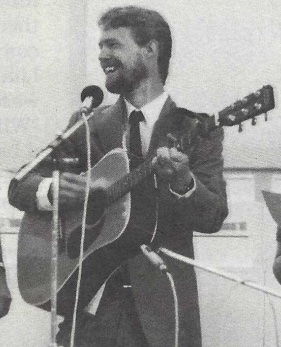
It was on Lee Hatcher’s recommendation, in 1992, that I was invited (on relatively short notice) to replace Nobel Peace Prize winner Wangari Maathai as the ICA International’s opening speaker, after Maathai was obliged to cancel. She needed to remain in Kenya because of political threats to her and her organisation.
Giving the opening address, as a substitute speaker, in front of 200 people from 29 countries, was a huge challenge for me as a then 30-something local community organiser. But it was also an enormous opportunity.
Recently, when reflecting on that opportunity, I realized it was time to send the ICA a thank-you note.
*
3 August 2026
Dear ICA folks,
Greetings from Stockholm. Recently, I formally retired — though I remain active as an author and university lecturer. I am glad to discover that ICAI still exists and seems, on the website, to be quite vital and energetic.
I am writing to you now because, in reflecting on my career, I felt a surge of gratitude for the invitation I received from ICA International, in 1992, to serve as your opening speaker in Prague.
I was a late substitution for the originally booked keynoter, Wangari Maathai. She was unable to leave Kenya at that time, for political reasons.
So, recommended by people at your former Seattle branch (where I lived at the time), ICAI took a chance on me, the young (then 32) co-founder of a local sustainability initiative, “Sustainable Seattle”, a program that was making some noise internationally. I was also, up until just before you invited me, executive editor of the magazine In Context, one of the first journals on sustainability and cultural change. In fact, I left that magazine position just a couple of months before delivering the keynote. Going to Prague essentially marked my first professional engagement in my new role as a sustainability consultant and speaker.
In fact, delivering the “Opening Address” for ICA was the launch of my international speaking career. I built some songs into the Prague keynote — it was the only way I could try to fill such huge shoes as Wangari Maathai’s — and that seemed to work well with the ICA crowd.
After that, and for the rest of my career, I added songs to most of my presentations. That career took me to over 50 countries. I have done hundreds of speeches, lectures, and workshops over the years, on sustainability-related issues. Adding a song or two (about economics, climate change, or even systems thinking) became one of my “unique selling points” as a speaker — though of course I rarely sang in official UN or government settings, where I worked for much of the last 20 years. But even there, sometimes music had its place.
It is inconceivable that I would have done any of that, bringing songs into my speeches, if ICAI had not invited me to speak in Prague all those years ago, and accepted my proposal to add music to the keynote.
A very warm and hearty thanks, decades later, for placing that trust in my younger self, and for providing me with a wonderful starting experience in that aspect of my career. And my warmest hopes for ICA’s continued work to do something so important: bring people together and facilitate positive social change.
Very sincerely,
Alan AtKisson
*
The ICA’s Internet archive includes a newsletter documenting the 1992 conference in Prague at this link. Here is the complete photo that I had cropped above, with caption and credits, from that newsletter. Below this photo you will find a short excerpt from the newsletter summarising, from the editor’s perspective, the key messages of my opening address. Rereading those, 34 years later, was an eye-opener.
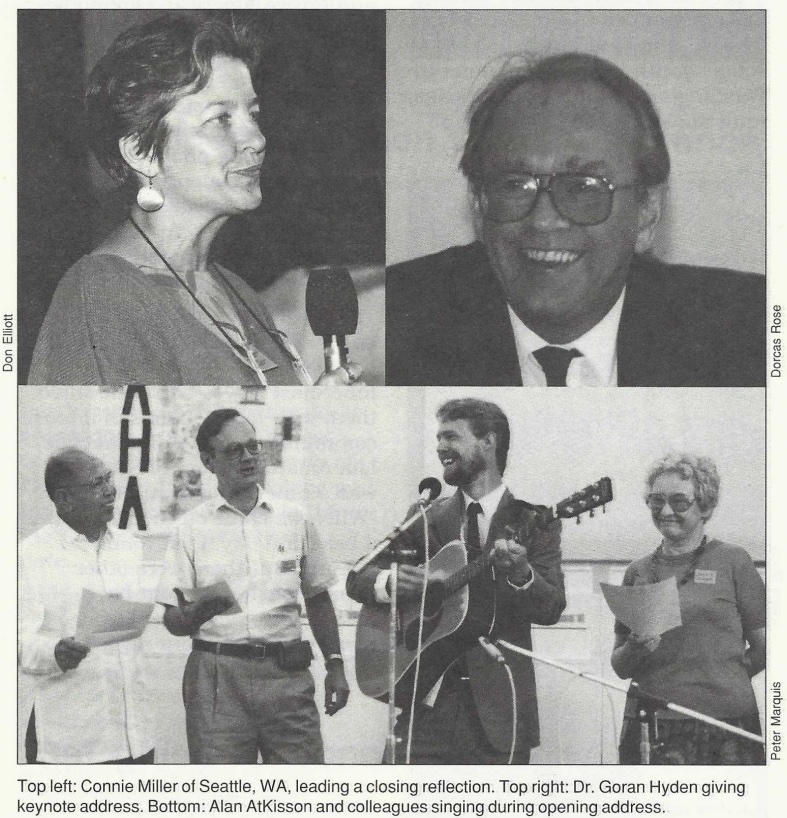
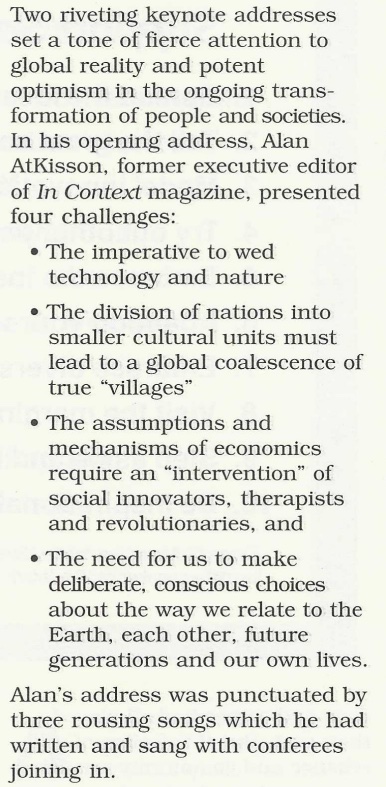
FYI, those “rousing” songs were “Dead Planet Blues,” “I Love, Therefore I Am,” and an anthem-y closing tune called “And We Rise” (which I have never released). Closing with “And We Rise” got everyone on their feet to sing the chorus together, using lyric sheets. Later, I realized that this was a very sneaky way to get a standing ovation, deserved or not.
If you are familiar with my published work, you will see that I have been quite consistent in my messaging about sustainability transitions, for many years now — though I was quite wrong about predicting that nation states would decline in importance in favor of villages. I also no longer hold the view that we need to (or could, or should) downsize from current nation-states to smaller entities, at least not universally. The world is complicated, and in some cases, I now favor movement in the opposite direction, including greater European integration and a stronger United Nations. I also should clarify the point I made about economics being “crazy”.
Why did I make that comment about “villages”? Partly because I was subbing for Wangari Maathai, an inspiring figure in the “Eco-Villages” movement that was growing at that time; I wanted to include her wisdom about that, in absentia. And partly, it was the end of the Cold War, and many people were making bold, now naive-sounding declarations about what was likely to happen next, such as Francis Fukuyama’s famous book about The End of History, which came out the same year. (History, as has widely been observed, came back.)
To provide a more nuanced context, here is what I actually wrote in my speech at the time:
“Most places in the world experiencing spasms of ethnic nationalism have long been subject to imperialist and statist domination. Whether they are Estonians, Palestinians, Quebecois or Native Americans, these are peoples who feel they’ve not had the chance to determine for themselves who they are in relation to the rest of the modern world. By supporting them in their quest for autonomy and a peaceful self-identity, even if that means the creation of dozens of new sovereign nations, we increase the chances that a true global community of cooperative, independent, high-self-esteem peoples can develop. Political unity among differing peoples cannot be forced or it will never be authentic, as the break-up of the former Soviet empire are demonstrating vividly.
In the world’s older democracies, many people are looking increasingly to both local and international arenas as their locus of political meaning, and decreasingly to the nation-state. Their loyalties are defined more by values than by borders. They are spontaneously assuming roles as local authorities and global diplomats, crafting policy statements, and even drawing up international “treaties” with each other. They increasingly feel themselves to be citizens not of their country, but of their community and their planet. And the international linking of economies through vehicles such as Europe’s Maastricht Treaty or the North American Free Trade Agreement will only accelerate that process by diluting the centrality of the nation-state still further.
Instead of ‘divide and conquer,’ our path may be ‘divide and coalesce.’ If all goes well and these trends continue, we could see in our lifetimes the emergence of a true global village, in the form of a globe of true villages.”
— Excerpted from “Making the Great Transition: Our One World,” opening address to the Institute of Cultural Affairs international conference, Prague, 1992. Complete text of the address published in Because We Believe in the Future: Collected Essays on Sustainability 1989-2009, Alan AtKisson, 2012, p. 13 and following, available via Amazon.com and Kindle Direct Publishing. Or write to me if you would like a PDF copy.
As noted above, I could not have been more wrong on that last point. It is now 2026, and while we have certainly divided, we have not exactly coalesced.
On the issue of needing to reform economics, I have subsequently written parts of books and even a song or two on that theme, and I still promote the same views. But here is what I actually said in Prague.
“Given its craziness [for example, GDP going up when disasters happen], economics needs the attention not just of social innovators, but of therapists and revolutionaries. Change is happening, but our economics should not be considered sane until the following reforms have been instituted: (1) turn the invisible hand into an ‘intelligent hand’, by promoting the judicious use of regulatory incentives to ensure sustainable practices within the free market; (2) internalize of the externals, so that reality is more accurately represented in our accounting statements; and (3) promote the philosophy and practice of prosperity through material frugality.”
— Same citation as above.
Today, having spent decades in diplomatic and change work, I would drop the rhetorical flourish about “therapists and revolutionaries,” and I would change point (3) to talk in terms of economics being “flawed” or “incomplete” rather than “crazy” (though GDP still goes up when bad things happen like war or accidents, which cause certain kinds of economic activity, and that is still pretty crazy). And I would probably use words like “radical efficiency,” “circular economy,” and “dematerialisation” rather than “material frugality”.
But I still think economics needs an overhaul. Points (1) and (2) need no editing at all, 34 years later. They are just as relevant today as they were in 1992. Unfortunately.
So, thanks again, ICA. Giving that speech in Prague remains one of my favorite professional memories. Remembering it now was helpful in thinking about the present and the future of sustainability work. And thank you for all your wonderful, world-changing contributions to our field. May you have many more decades of continued success in social innovation and community organising for sustainable development!

