I do not like being in marches or demonstrations. They make me nervous. But I forced myself to join the 50,000 people marching in Stockholm yesterday to call attention to climate change. It was uncomfortable — but it also felt good.
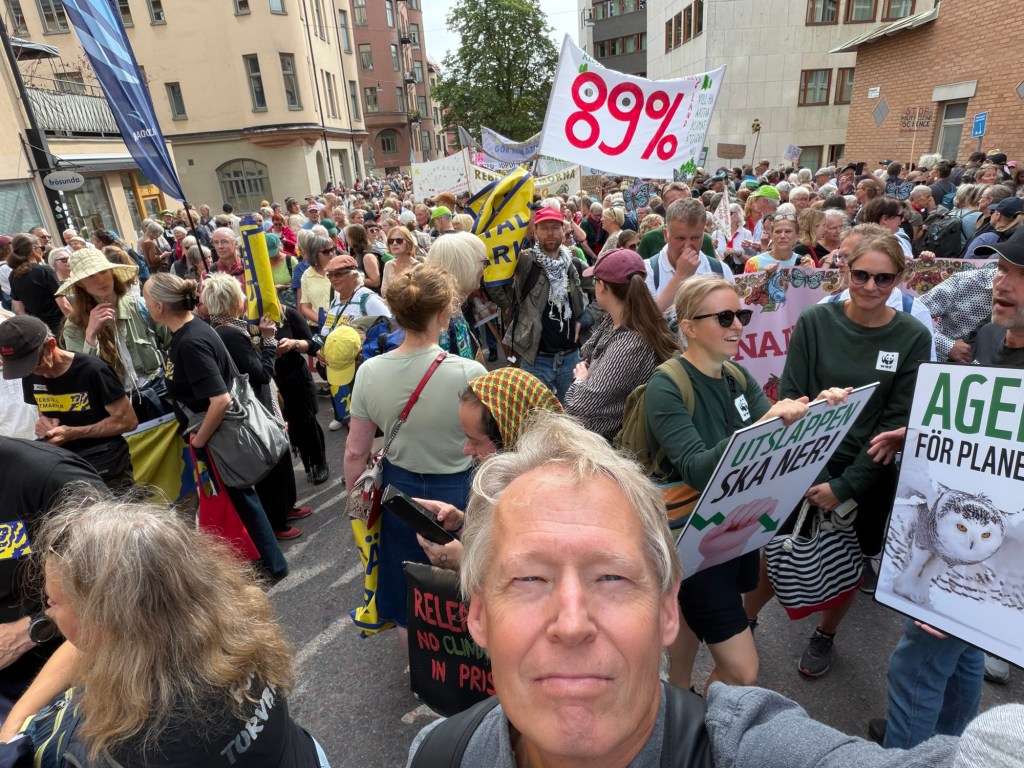
The reasons to join were compelling. It’s not just ”evidence” that is piling up now, especially here in Europe. It’s disaster. This summer’s heat waves, droughts, half-empty rivers, and fires are linked to our continuously rising emissions into Earth’s delicately balanced atmosphere. There is no longer a credible, scientific “maybe” anywhere near that statement. It’s happening.
But here in Sweden, in the midst of a national election campaign, our politicians are barely talking about it. One widespread concern, shared by many friends and commentators of varying political backgrounds, is that no party is talking about a long-term vision for building a better society. The campaign is all about short-term, money-in-your-wallet stuff.
Vision matters. Today, seriously addressing climate change has to be a key part of any long-term political vision, in any society, anywhere.
Sweden used to be a country that ”got it.” It instituted the world’s first tax on CO2 in the early 1990s (it worked beautifully). In 2018, it instituted a special governance body called the Climate Policy Council (”Klimatpolitiska rådet” in Swedish), described as ”an independent, interdisciplinary expert body tasked with evaluating how well the Government’s overall policy is aligned with the climate goal of no net greenhouse gas emissions by 2045.” Established by law, it is designed to not be political and look objectively at what the government is doing on climate.
The Council’s current assessment is: not enough. Very much not enough. Going backwards, actually.
So, despite my discomfort, I joined my wife Kristina “Kicki” AtKisson, who works with WWF on transforming business, to march with them.
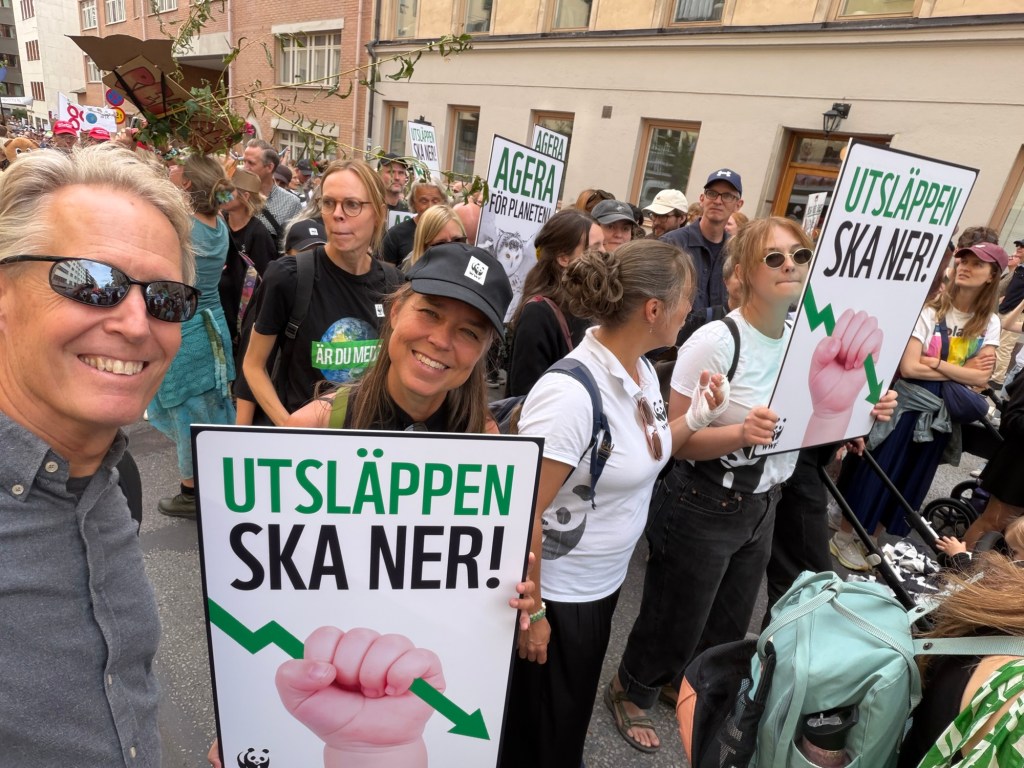
WWF was one of about 275 organisations and groups who participated officially. They had a very basic, clear, non-political (in party terms) message: emissions need to go down, not up.
And that won’t happen without political leadership. As well as leadership in business, civil society, faith-based organisations, education, you-name-it.
Individuals acting alone can’t do it, because systems change is required. So it felt good to be one of 50,000 people, very visibly acting together.
At the beginning, we just stood still for a while. Then came instructions to back up: apparently, there were so many people joining the march that they had to lengthen the march-train, backward, so that everyone could fit into their assigned slot.
We backed up a lot. And we waited a long time, almost two hours. Just when the situation was starting to feel hopeless, someone with a bullhorn informed us that the reason we were standing still was, again, the unexpectedly large turnout. In fact, the front of the march (we were in the middle) had already arrived at its destination.
Finally we started shuffling forward. Then strolling. And finally, striding briskly together through the streets of downtown Stockholm.
I could not help thinking that all of this was symbolic. Going backwards. Standing still. Finally surging ahead.
That is exactly what trying to make progress on climate change feels like these days. Or at least, I hope so: the “surging ahead” part is still a question, both of politics and leadership generally, in this society, and in many other societies around the world.
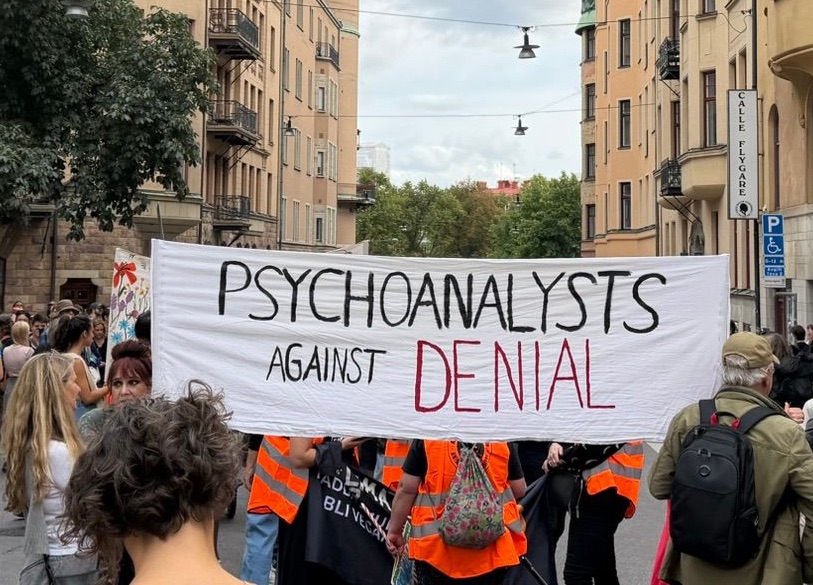
I hope the message of this march, to leaders of all parties and institutions, here in Sweden and elsewhere — “You need to do more, do better, starting now” — will finally get through the many, many layers of denial.
*
Subscribe to my blog, “Words&Music,” as a newsletter by clicking the “Subscribe” button. Also published at Substack. The newsletter is free.