On the 13th of March, 2026, Donella “Dana” Meadows might have been celebrating her 85th birthday. But Dana passed away exactly 25 years ago (plus a few weeks). Not quite 60 years old at the time, she was taken in the full flower of her career by a sudden bacterial illness. The randomness of her early death still seems deeply unfair, and I am struck by how often I still feel her absence. But I am also happily amazed that she remains so very present in the lives of the people who knew her personally, or who know her — or indeed, are just getting to know her — through her work.
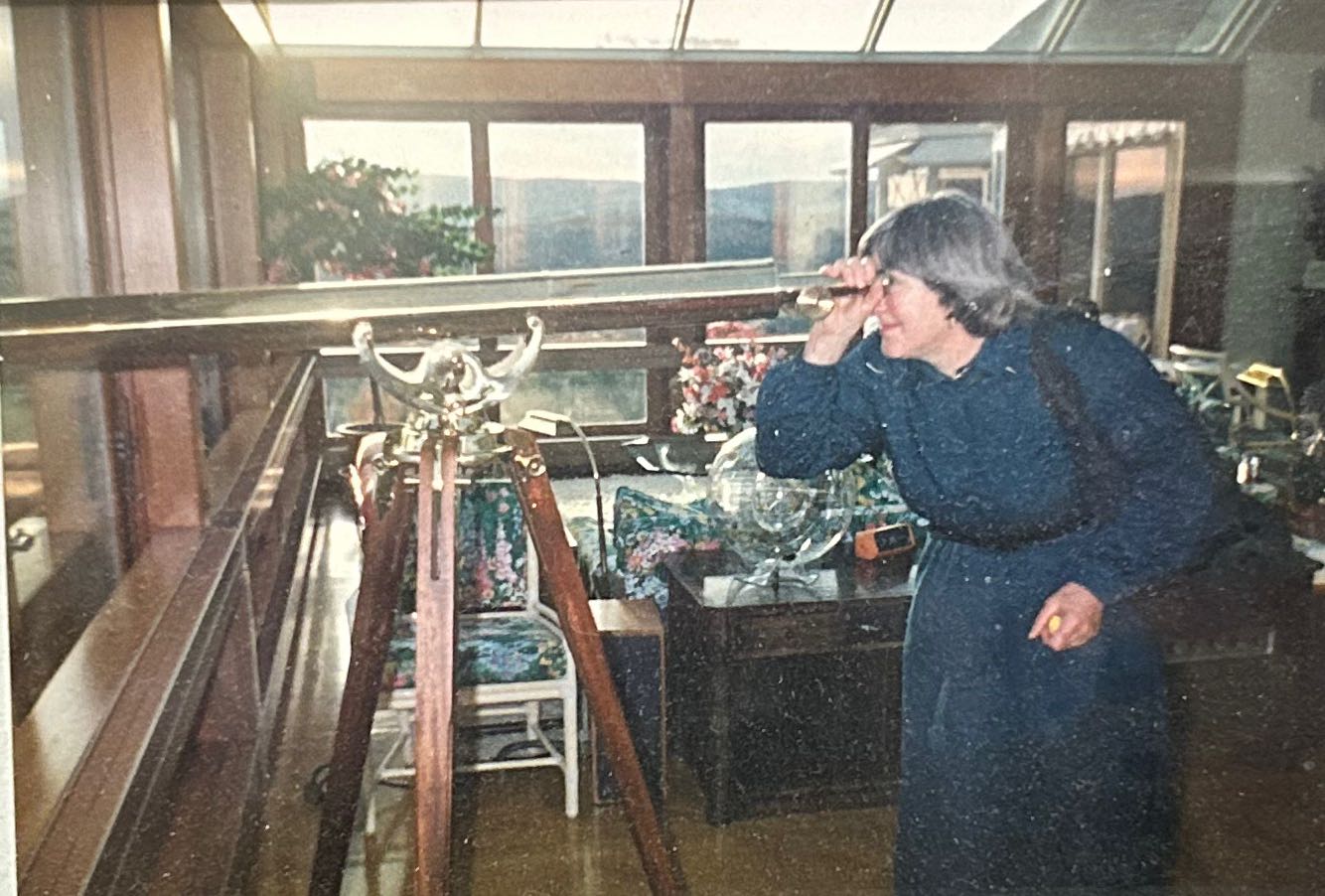
Who was Dana Meadows? That is a surprisingly difficult question, and one that has gotten harder to answer with time. An inspiring personality. A brilliant scientist. A gifted communicator. An uncompromising idealist. A devoted gardener. A demanding teacher. An indefatigable networker. A person with the ability to look at you, smile with an actual glint in her eye, make you feel special and seen, and then convince you to do almost anything. Or at least, convince you to try.
Publicly she is known as the lead author of the phenomenal bestselling book The Limits to Growth (1972), the person who created the public written voice of the global modeling team led by her former husband, the equally brilliant Dennis Meadows. Her “day job” was teaching at Dartmouth College, but she found many other channels to spread the word about sustainability. She was a Pew Scholar, a MacArthur “Genius” grant-winner, and a widely-read syndicated columnist whose articles, under the banner “The Global Citizen,” translated complex systems concepts into folksy newspaper prose. Remember, there was no LinkedIn or Substack in those days. Getting one’s words read so widely, driven by word of mouth recommendations and paper-based photocopy machines, was a fantastic accomplishment in its own right.
To her friends, Dana was an unstoppable force of Nature. As the co-founder (again with Dennis) of a very influential global research network, the Balaton Group, she helped to spread innovative sustainability and systems ideas to nations far and wide — and again, this was much more difficult in the days before the Internet took off. She also founded her own sustainability research institute, and became the driving force behind the building of what was, at the time, a cutting edge ecological community. At Cobb Hill CoHousing, and at the Sustainability Institute, people who were attracted by the power of Dana’s vision came to live, work, and even play sustainability.
I never lived at Dana’s Cobb Hill, or worked at her Sustainability Institute (which now goes under another name, the Academy for Systems Change). That was one of the few things Dana did not succeed in convincing me to do, though I was proud to bear the volunteer title “Director of Arts & Culture” for her Institute. The title was an honorific earned by my history of whipping up songs related to various sustainability topics, often at Dana’s direct request, and then playing them on demand, like a bard. “We need a song about the problems of economic indicators!” she would say at the end of a seminar on that topic, looking right at me and smiling that mischievous smile. The next day, by dinnertime, I would present a new tune like “The GDP Song.”
I do remember the phone call when I finally told Dana definitively that I would not be taking the formal job she was offering me at her new Institute, or joining her in the process of building the cohousing project. (Sadly, she died before she could move in herself.) I was more attracted to travelling and promoting sustainability in other ways, in other parts of the world, rather than settling down to community life in semi-rural Vermont. She took my decision in stride, stopped trying to convince me, and immediately changed gears to encourage me to follow my own sense of calling, and help me realize my own vision for sustainability work.
This whole-hearted support of others and their visions was typical of her way of being, not just with me, but with so many of her other friends, colleagues, students, and even her readers. She was a visionary, and you did not come away from an encounter with Dana Meadows — personal, or literary — thinking small thoughts. She invited you to think big, and in fact, she insisted on it. And then she showed you how turn that vision into reality, using the power of systems thinking, social networking, and a whole lot of love.
I had the privilege of knowing Dana personally, and of even calling her my mentor (though she disliked that word). I owe a huge percentage of my career, and even my current personal circumstances, to her suggestions, encouragements, and interventions. But I do not think it is necessary to have known Dana to get some of the “Dana Meadows Effect” in your life. Read her professional books and papers, sample her insightful columns and chatty “Dear Folks” newsletters, dig into the beautifully preserved archive at “The Donella Meadows Project.” It is a great way to get to know her. Dana really “put herself out there,” writing about her highs and lows, her dreams and disappointments, decades before radical transparency became a social media cliché.
If you at least dip into her work — and I sincerely hope that you do, in honor of her birthday, even if you are already familiar with it — you can discover something else, too, something that is even harder to put into words. Dana was often a bubbly, cheerful person, which comes through in her writing. But of course, not always. She had her moods, as we all do. What she did seem to always have, however, was something much deeper than mere cheerfulness: a sense of strong and consistent joy, grounded in the belief that she was doing her best, doing what she could do, to make the world a better place. Even when the work was very difficult indeed.
In that spirit, I will close this remembrance of my dear friend and mentor, Donella Meadows, with one of the quotes featured at her archive. It reflects, in a sentence, that balance in Dana that I have tried to convey here, the way she was true to her own vision, but also true to the visions of her friends and colleagues, in equal measure. She valued other people’s joy, achieved on their own terms, as much as her own. That is a surprisingly rare quality, one much needed in our world, and therefore one — along with so many other wonderful qualities that Dana not just had, but shared with the world — to which I personally continue to aspire.
“It’s because of the people who are working toward sustainability, and because of my own experience, that I know how quickly the decision to go that direction, though it may start out with a feeling of sacrifice, turns into a lifetime of rejoicing.”— Donella Meadows
Want another take on “Who was Dana”, with more words from Dana herself? Check out this lovely article about her on the Donella Meadows archive: “Dana: teacher, mentor, friend, pillar, beacon, guiding star,” by Kylie Flanagan.
Shortly after Dana passed away in 2001, I wrote several other pieces about her, including an official obituary (together with our mutual friend Joan Davis). Links below.
“Donella Meadows, lead author of ‘The Limits to Growth’, has died,” Alan AtKisson and Joan Davis, Ecological Economics Volume 38, Issue 2, August 2001, Pages 165-166
“The Brightest Star in the Sky,” Alan AtKisson, Ecological Economics, Volume 38, Issue 2, August 2001, Pages 171-176 (also free to read at this link)
“Love, Dana”, speech by Alan AtKisson at Donella Meadows memorial service
Many other tributes to Dana, written just after her passing 25 years ago, are available at this website: https://donellameadows.org/archives/the-balaton-bulletin/
 Alan AtKisson