What happens after our shock fades? That was the question asked by an old friend and colleague of mine, Robin DiAngelo, and her writing partner Delta Shelby Larkey in an opinion article published in the Minnesota Star Tribune a few weeks ago.
For those of us who count as ordinary people, and who were glued to the media in January as the act of protesting in Minneapolis became deadly and the world grappled with a US president threatening to take Greenland by force, the answer is already here.
Old shock gets replaced by new shock — at something else.
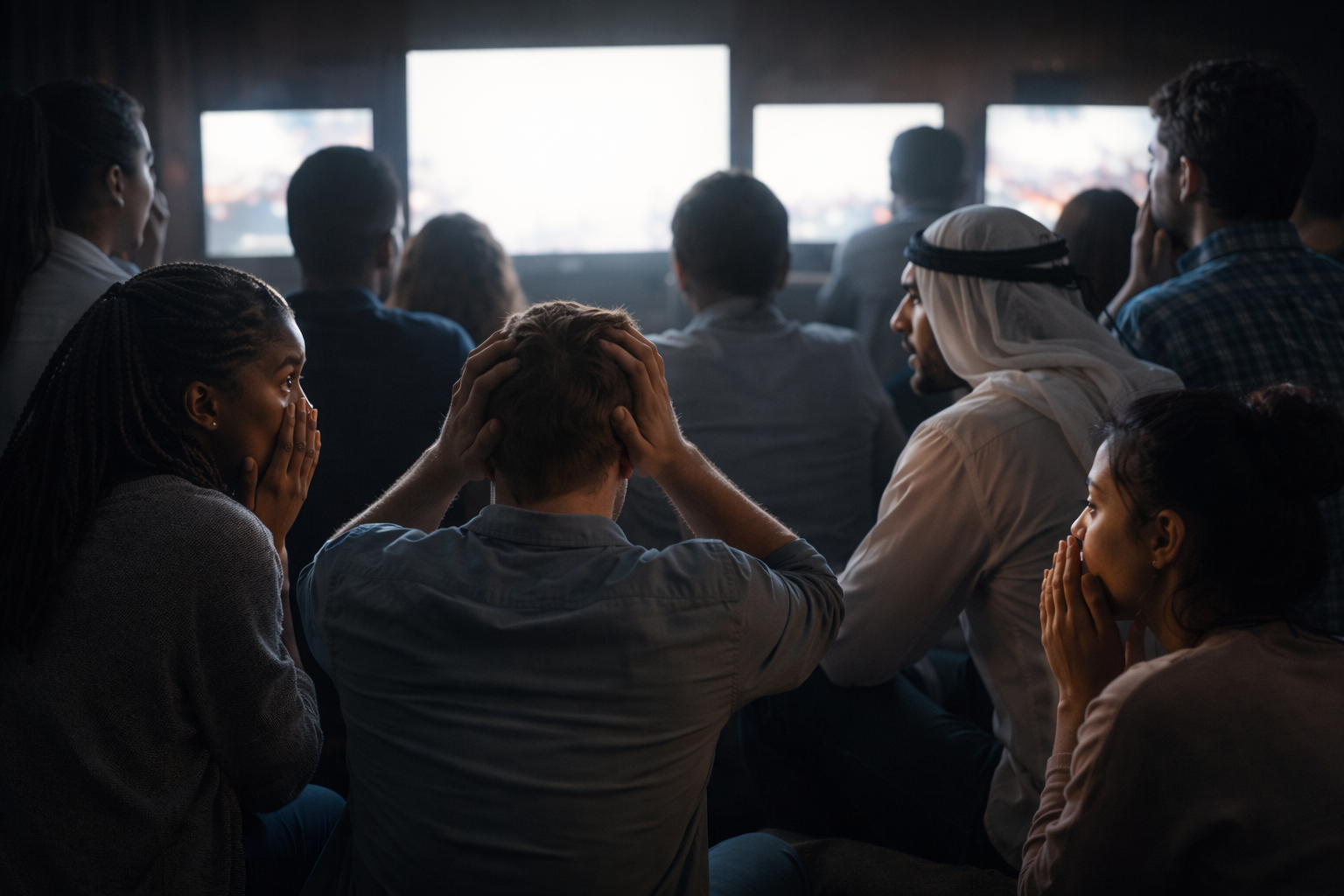
Most people I know were shocked by the recent joint US and Israeli attack on Iran, which seems to have launched a new major regional war, further pushing existing brutal wars (Russia’s war in Ukraine, ongoing massacres in Sudan) into the media background.
No doubt this new shock will also be replaced by something else shocking within a few weeks. What is happening now will become the new normal. What happened in Minneapolis and in the political dialogues about Greenland’s future has already become yesterday’s, or rather last month’s, news.
That’s because shock is not sustainable. Shock is, my AI tells me, a “rapid disruption of expectations”, which triggers certain strong emotions and physiological reactions. But eventually the emotions fade and whatever caused the shock becomes an “habituation,” something we have gotten used to, or even part of the “background structure of reality” — sometimes in just a few weeks. (And sometimes, getting the public to the point of accepting a new reality, quickly, is the goal that motivates the use of shock.)
“The brain learns that the information is not immediately actionable, so it reduces arousal,” my AI explained to me, before also writing about “compassion fatigue.”
The latter could explain my complete silence in the public sphere throughout February, which surprised even me when I realized that an entire month, full of shocking events, had passed without my posting so much as a tweet. (Or what used to be called a tweet. I still find it a bit shocking that tweets have disappeared. I am not yet “habituated.” For personal reasons, I do not post “replacement tweets” on “formerly Twitter,” either.)
However, I did not feel my compassion leave me. I still felt a deep ache of compassion, and a certain amount of collective shame (since I am white), for all those people, both famous and not, who were subjected to blatant and very public racist insults in February, for example. I felt deep compassion for the teenagers here in Sweden who, upon turning 18, are being deported from this country, even though they had grown up here, even though this country is their only real home. And on the fourth anniversary of Russia’s full-scale invasion of Ukraine, my capacity for compassion felt tested to the extreme: it is inconceivable to me what the Ukrainian people have endured, and must continue to endure, in the face of unrelenting and merciless Russian aggression.
Apart from feeling compassion, using my right to vote, and expressing myself in public in various ways, there is not much I can concretely do about any of that. So a better phrase might be, “not-immediately-actionable fatigue.” Or just, fatigue. As a retired person, my options for action feel more limited, which is weirdly fatiguing. My principal arena for action is writing on social media. Whereas in my former professional roles I might have been calling meetings to discuss our organisation’s responses to whatever was happening, or making public statements based on our commitments to human rights and international law, now I simply read the news, absorb the latest shock, and decide whether or not to say anything publicly.
Since I prefer to be careful about what I say publicly, because I do not want to contribute to the pervasive climate of polarization, anger, and derisory speech, every statement I make takes considerable time and energy. As a result, I wrote very little on my book in January. All my writing energy went into trying to say something thoughtful, helpful, or at least not damaging about various shocking events during that month. In February, by keeping silent in public and directing my energy into my book, I finished a whole chapter and started another. Speaking out is important, but silence brings its own rewards.
So for those of you who have kindly responded to my essays and posts, encouraging me to keep on writing, thank you. If I am quiet about a specific shocking event, it is not because I do not care; I am just trying to manage my personal energy budget.
One reason I wrote the essay “Loyalties”, which lays out my core values and intellectual commitments, was to make my thoughts and opinions even more transparent than they already are. Anyone who has read my work or watched my career in sustainable development can easily guess what I am likely to think about many current events. I know, because in my experiments with AI, it seems quite good at predicting what I am likely to say about virtually anything. At least, what I would say publicly. (To be clear, I do not use AI to generate writing, only for research and background, as a kind of editorial assistant.)
What would I have said in February? I deeply disapprove of war and prefer diplomacy, though I support what Ukraine is being forced to do now, for example. I denounce racism as well as gender- or sexuality-based discrimination in all its forms (since I am a white, privileged, heterosexual male, this is especially important, as Robin and Delta’s article reminded me). I fervently believe in the power of democracy and the universal application of human rights. I am convinced we need to transform our economies to live within the boundary conditions for sustaining a living planet, and so on. “Loyalties” sets a frame that I try to adhere to, because that is the kind of world that I would prefer we create.
And no, I do not consider any of that to be an unrealistic agenda for the global future. I just think the work of realizing that agenda is taking, and will continue to take, time. Progress on these matters advances and retreats. It catches the wind and then loses it, or meets active or even violent resistance, then recovers, and starts again to move forward. I remain optimistic about this agenda in the long term, because the number of people working actively to create a better world — a sustainable, just, and inclusive world — has been steadily growing, for decades.
As John Lennon said, “You may say I’m a dreamer, but I’m not the only one.” Far from it. That reality, the fact that this better dream for our future seems unstoppable in the long-term, is what continues to give me hope.
I will continue to pay attention to the news in these strange times, and I will sometimes say something about current events, even if I think my views are predictable. But in coming posts, I will mostly turn my own attention and energy back to the long-term agenda of creating a sustainable and desirable future here on planet Earth.
That declaration of intent may not be shocking. But it will not fade.
*
 Alan AtKisson