 Alan AtKisson’s books include two bestsellers that have sold tens of thousands of copies — Believing Cassandra and Sustainability is for Everyone. These two, as well as two of his other books — The Sustainability Transformation and Parachuting Cats into Borneo (with Axel Klimek) — have been used in many university courses and professional training programs in sustainability.
The Sustainability Transformation includes an introduction to the sustainability tools Alan developed and helped to spread around the world, including the Sustainability Compass, the Pyramid workshop on sustainable development, and the Amoeba training in professional change agentry. These tools are now owned and managed by a non-profit organization, Compass Education. (For a quick video introduction, see Alan’s TEDx-talk from 2014.)
The following is a complete catalog of Alan AtKisson’s books
2020 – The Chronosphere Commentary: Reflections on a poem about time
(Broken Bone Press)

In 61 short essays, AtKisson interprets his own long poem from 1997, written in 61 verses and dedicated to a friend who was dying of cancer. The poem itself, “Chronosphere”, is focused on questions related to time, life, death, and sustainability (the field to which his friend had dedicated his own life). The book started as a series of letters to the friend’s daughter, who had written to ask about the meaning of the poem. The Chronosphere Commentary takes the reader on a spiraling path through philosophy, science and poetry (with dashes of humor) and closes with a moving remembrance of the friend’s confrontation with the end of life. Available through any bookstore. Click here to visit the special interactive website where you can order the physical book and explore the text, free. (Anytime.)
2016 – Parachuting Cats into Borneo — and Other Lessons from The Change Café

(Chelsea Green)
A toolkit of proven strategies and practices for building capacity and creating transformation (co-authored with Axel Klimek)
Two out of three efforts to create change in companies, organizations, etc. fails to achieve its desired result. How can you buck this long-standing trend? In Parachuting Cats into Borneo, Axel Klimek and Alan AtKisson offer crisp, concise, and targeted advice for success. Drawing on decades of helping corporations, networks, governments, and NGOs reach their change goals, the authors show you how to use systems- and sustainability-based change tools — and more importantly, how to develop your own capacities, question your assumptions, and learn to navigate complexity with attention and purpose. Called “insightful” and “particularly valuable” by Publisher’s Weekly, and widely praised by leaders in business, change management, and sustainability. READ MORE
2013 – Sustainability is for Everyone
(Multiple publishers in multiple languages)

This 50-page, simple and inspiring introduction to sustainability has been translated into several languages (including German, Japanese, Swedish and French), purchased by companies and universities for distribution to all their employees and alumni, and sold tens of thousands of copies. Written on the occasion of Alan’s induction into the International Sustainability Hall of Fame in 2013, and intended to help sustainability professionals reach new audiences by using simpler concepts, Sustainability is for Everyone became a surprise bestseller for Alan’s small, independent publishing imprint when it was discovered to be an effective way to engage newcomers to the field. More than 30,000 copies have been purchased, but now the book has also been available free in PDF format. The second edition includes an extra preface about the United Nations Sustainable Development Goals (the “SDGs”). READ MORE
2010 The Sustainability Transformation: How to make positive change in challenging times
(Updated paperback edition Routledge/Earthscan 2010)

Alan’s second book served as a professional introduction to the practice of sustainability (as it was practiced in the first decade of the 20th century). As in Believing Cassandra, the writing style mixes personal stories with clear explanations, tools, and case studies. The Sustainability Transformation introduces the reader to the tools and methods Alan developed in the late 1990s, which later spread around the world, helping people and organizations to start working with sustainability quickly and effectively. The book also digs deeply into the challenges and opportunities facing anyone who decides to become a sustainability change agent. Called “essential” by Bill McKibben and Hunter Lovins, the journal Ecological Economics noted (in a formal academic review) that “The book is inspiring and informative, and offers clear and easy-to-follow framework and tools.” See the full review in the journal Ecological Economics, May 2011… READ MORE
1999 / 2010 – Believing Cassandra: How to be an optimist in a pessimist’s world
(Routledge, 2nd edition 2010)

Alan’s first book became an instant Amazon bestseller in its category upon its release in 1999 and was translated into several languages. Mixing easy-to-digest scientific explanations with moving personal diary entries, the book captured the attention of leaders and changemakers in widely varying organisations, from the US Army to the United Nations Environment Program. Updated for a second edition (with a new publisher) in 2010, Believing Cassandra was long used as an introductory coursebook at universities and was purchased in bulk by companies and government agencies for employee training programs. Paul Hawken called the book a “neurotransmitter” that makes connections between sustainability, science, professional work, and people’s own lives. According to many readers, it also achieved Alan’s stated goal for the book: to inspire more people around the world to begin working on building a sustainable future. READ MORE
2012 – Life Beyond Growth: Alternatives and complements to GDP as a measure of progress
(Random House, Tokyo , 2012, Japanese only) (Free report version, in English, available here.)

“Life Beyond Growth,” published in book form in Japan (where Junko Edahiro joined it as a co-author), was available free of charge in English in its original report format. The report covers the history of economic growth as a concept and the rise of the GDP as its principal measuring stick, then introduces the array of critiques and alternatives that had arisen to challenge those concepts (as of 2012). The report demonstrated how countries and cities around the world were using new measures of progress and wellbeing to complement the GDP. Presented at a global OECD forum in 2012, and cited by other authorities such as the United Nations, “Life Beyond Growth” closed with a look at the future and concluded that a combination of the emerging new economic ideas — “Green Economy” + “Gross National Happiness” — was key to achieving a sustainable world.
2012 – Because We Believe in the Future: Collected Essays on Sustainability, 1989-2009
(Broken Bone Press)
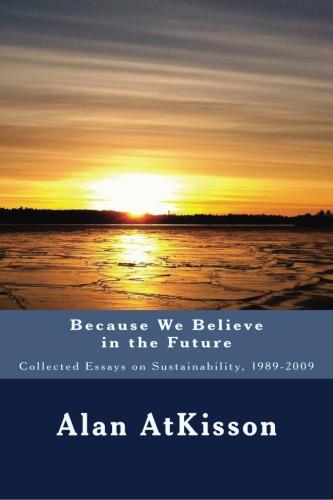
Because We Believe in the Future is a compilation volume that acts as a tour through the history of sustainability from Alan’s unique perspective, via his essays, speeches, blog posts and other short pieces collected over a 20-year period (1989-2009). The collection includes Alan’s moving tribute to his mentor and friend Donella H. “Dana” Meadows, “The Brightest Star in the Sky”, as well as the essay that inaugurated a UN-sponsored Knowledge Partnership, “Pushing Reset on Sustainable Development.” You’ll also find his best early columns, including a piece that went viral on the Internet (long before Twitter and Facebook): “Dear Santa, I Hear the North Pole is Melting.” READ MORE
2012 – Collected Poems, 1982-2009
(Broken Bone Press)

The publication of Collected Poems 1982-2009 marked the first time that Alan AtKisson’s poetry, which previously appeared only in small literary journals and chapbooks, had been published all together in one place, in book form. The collection includes his best early work as well as his two long poems, “Chronosphere” (described above, republished in The Chronosphere Commentary) as well as “Screed”, a multi-genre mash-up on the folly of global civilization in an era of climate change. AtKisson is not a prolific poet, but he is serious about the craft and his love of language. His work also references and mimics modern masters (“Screed” was partly inspired by “The Wasteland”), but sometimes dispenses with them humorously, as in the early poem “Purging Wallace Stevens”: Call the roller of big cigars and tell him to / get his ass out of town …” READ MORE
 Alan AtKisson