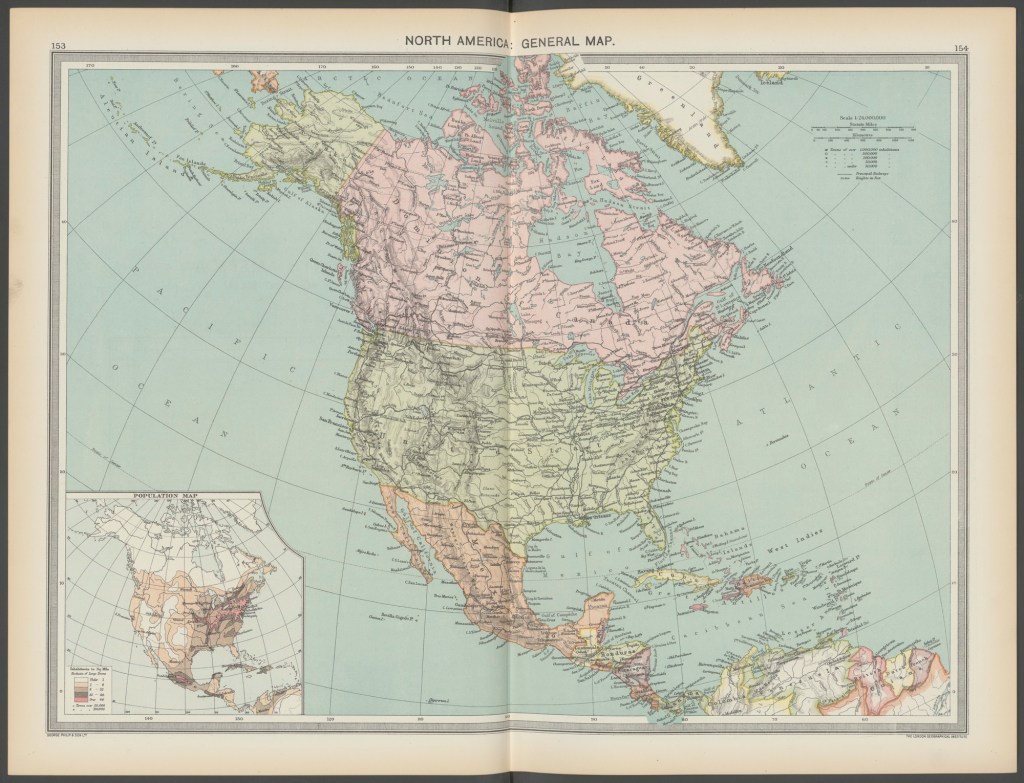
As a child growing up in America, Canada was to me a total mystery: an enormous pink-coloured blob (in my memory it was always pink) on the northern side of a weirdly straight line drawn across the top of the continental United States. We learned nothing about it in school that I can recall — no history, politics, culture, or geography. The only thing I remember knowing about Canada, politically, was that it was to Canada many American Vietnam-War draft-dodgers ran in order to avoid military conscription. It was therefore a suspicious place.
I relate this anecdote as a way of underscoring the importance of Mark Carney’s speech at the World Economic Forum in Davos. With one powerful act of political rhetoric, Carney put Canada back on the map. In fact, he put Canada right at the center of a global discussion on how to sustain some vestige of a rules-based, democratic vision of global progress, which he tied explicitly to upholding human rights and achieving sustainable development.
Carney is, to use the vernacular, one smart cookie. He knows his history, political science, and especially his economics. He has degrees from both Harvard and Oxford. He rose through the ranks of finance and ended up heading the central banks of both Canada and the UK before improbably jumping into politics and getting elected prime minister. So when Carney refers to the current political reality as a ”rupture” with the past order of things, believe him. When he quotes Vaclav Havel, a dissident writer turned politician who knew something profound about living in the shadow of hegemonic power, he is doing his best to rescue the word ”truth”.
Carney may be leading the left-leaning Liberal Party in Canada, but he is certainly a centrist — business-friendly, socially progressive, and a firm believer in the value of science to inform policy. (One of his many roles was as Special Envoy on Climate Action and Finance for the UN Secretary-General, where I had the privilege of watching him in action during my previous government role in Sweden.) When he quotes Finland’s president Alexander Stubb, a liberal-conservative, on the topic of a new ”values-based realism,” he is signalling that centrist position clearly. It is worth reading the relevant paragraph from Carney’s speech:
”Our new approach rests on what Alexander Stubb has termed ‘values-based realism’ — or, to put it another way, we aim to be principled and pragmatic. Principled in our commitment to fundamental values: sovereignty and territorial integrity, the prohibition of the use of force except when consistent with the UN Charter, respect for human rights. Pragmatic in recognising that progress is often incremental, that interests diverge, that not every partner shares our values.”
Even today, Canada remains a bit mysterious to many if not most Americans. But they are not alone in that: many aspects of Canada are not as widely known as they should be, in the US, in Sweden, or globally (and I include myself in that criticism, I am the farthest thing from an expert on Canada though I have studied some aspects of it closely in my previous work). I wonder how many people know, for example, that the Canadian government ceded an enormous piece of its territory, which is now called Nunavut, back to Inuit self-governance in 1999?
By the way, Nunavut’s land area is about the same size as Greenland’s, it is Greenland’s immediate Western neighbour, and its population is even a bit smaller than Greenland’s. Isn’t it interesting that Nunavut has not been mentioned once, in any public statement that I have seen, during this ongoing global drama regarding Inuit-governed Greenland and Arctic security?
But Canadians understand Americans. They have to. As Pierre Trudeau once said to Richard Nixon, ”Living next to you is in some ways like sleeping with an elephant … one is affected by every twitch and grunt.” One senses that Carney has begun to feel that his southern bedmate is preparing to roll over on top of him.
Europeans generally understand Canada better than Americans, because Canada is, in many respects, more similar in general to a European country, and specifically to a Nordic country. (Remembering, of course, that French-speaking Quebec would probably be considered more similar to France.) It is no accident, then, that Canadian Carney quoted Finland’s Stubb, who has also emerged as one of Europe’s most interesting and pragmatic political thinkers. Living next to Russia tends to sharpen the mind, especially since Russia — Finland’s elephant — has tried to roll over onto Finland on multiple occasions.
What Carney’s piercing political rhetoric means when translated into practice, including his call for middle-power nations to collaborate more systematically, remains to be seen. I actually wish he were not correct in his analysis about the fundamental rupture in the existing geopolitical order. I also wish that a country like Canada — as good a neighbour as the US could ever hope to have, in any political universe — did not feel a need to ”model [its] response to a hypothetical American invasion.”
But ”if wishes were horses, beggars would ride.” Carney, inspired by Havel, is absolutely correct about at least one thing: those attempting to hold some kind rational, sensible, long-term sustainable center in this world will not succeed unless they also strive to ”live within truth.”
*
”Words and Music by Alan AtKisson” is also published at Substack. Please follow me there if you would like to comment on this article, or write to me personally via the Contact tab on this website.

 Alan AtKisson