Consider the Baltic Sea: Brackish. Beautiful. Highly polluted. Linking (or dividing) the following countries: Germany, Poland, Lithuania, Latvia, Estonia, Finland, Sweden, Denmark – and Russia.

It might irritate certain EU member states, not mentioned above, both current and former, to learn that for journalist Oliver Moody, Berlin bureau chief for The Times of London, the region defined by this set of countries — a region named after its uniting/dividing sea — is now “The Future of Europe.” This bold claim is also the subtitle of Moody’s captivating new book, Baltic.
The first eight countries named above constitute a hugely influential and innovative economic engine, often acting as pioneers to exploit, or even create, new markets. (Wind turbines, video calling, and digital music streaming are just a few examples.) More urgently, they are also the front line in a dangerous, ongoing, and intensifying “hybrid” conflict with the last country named. In Baltic, Moody makes a compelling case that this combination of economic opportunity and security threat has shifted the geopolitical focal point of European development significantly northward.
As an American-Swede, dual national, former advisor to several regional governments, former senior official, and long-time Baltic-watcher, I could not agree with Moody more. This region has always “punched above its weight”, often while being either mythologized or overlooked, languishing on the sidelines of official European history, treated as an exoticism or an afterthought. It is a pattern that has persisted for hundreds of years.
Of course I am biased. The happy accident of my living in Sweden was inadvertently facilitated by a Baltic regional cooperation program, “Baltic 21”, a collaboration among all the region’s governments (originally including Russia). Baltic 21 invited me to come lecture in the Spring of 2000, an invitation that ultimately led to a transformation in my personal life. By November of that same year, I was living in Stockholm, running my global consulting firm from here. For the next 17 years, as part of a growing global practice, I continued consulting on and off to the “Baltic 21” initiative, which was attempting to bring the region’s disparate nations into closer relationship around the hearth of sustainable development visioning and programming.
Meanwhile, I had discovered my personal hearth in the region as well, marrying a Swede whom I met on that first professional visit in 2000. Indeed, I once joked to the senior officials in the Baltic 21 steering group that our two children were a verifiable and concrete “result” of their strategic cooperation program. (Concrete results of international cooperation programs are often difficult to verify.)
But Oliver Moody, afflicted with no such personal biases, has a more clear-eyed and objective basis for his observations regarding the region’s growing importance. His book rests on hundreds of hours of journalistic site visits and interviews, as well as a reference list that fills more than 50 pages.
Moody makes two core arguments. The first is grounded in both historical and current security issues. Moody concludes that the EU states encircling the Baltic Sea “have been forced … to develop precisely the kind of broad and deep resilience for which other western nations are currently fumbling.” These are nervous times, but Moody’s deep dive into the tough core of Baltic region security questions leaves one with a sense of self-confidence and assurance. There is still much we can do to avert risk, but if the worst happens, we will be ready.
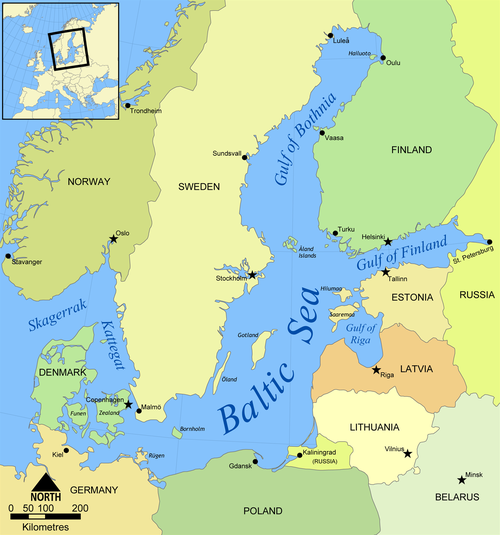
Moody’s second point is more subtle, and arguably more important in the long run: that the eight countries of the Baltic Sea region “are emerging as a new power centre in their own right.” One can go country by country and highlight the ways each Baltic Sea state has wielded outsized influence in European political and economic affairs. Add that up, toss in the urgency of supporting Ukraine and securing Europe’s eastern border, and then overlay a new sense of unity stemming from NATO membership. What you get is a new regional powerhouse.
The book itself consists of excellent journalistic summaries of recent history, together with forays into a wide range of possible future scenarios, including the unpleasant scenario of direct armed conflict with our “neighbour to the East”. Chapters focus on one country at a time but use each country as a lens to illustrate larger regional issues. The approach backs up Moody’s argument compellingly.
The book also makes for an exciting read, while giving even the relatively experienced Baltic-watcher a lot of new information to chew on. I have been active in this region a long time, running strategic planning processes, training officials, or analyzing economic trends. I should already have known, for example, the history of the 33,000 resistance fighters in Lithuania’s Forest Insurgency, who hid out in the woods and struck at Soviet occupiers from 1944 until the mid-1950s. That I did not know this before is my fault, but it also points to a general tendency: we in the bigger regional nations have seriously under-appreciated the inner strength of the smaller ones.
Moody surfaces many such historical nuggets, setting them in a contemporary context and using them to set the scene for interviews with today’s regional leaders. He explains how the historic left-right political divides in Poland and Germany subtly shape relations with Russia … how and why Estonia built its extraordinarily successful digital economy from the ground up … what historical memories unite (but sometimes divide) Finland and Sverige … how and why Denmark actually complained to Lithuania when the country boldly declared independence from the Soviet Union in 1990 … and these are just a few examples to give a quick impression of the book’s scope, which compresses a great deal of useful information into a brisk read.
I realize now that previously, I had only the vaguest working sense of Baltic regional history and how that history was influencing current events. Reading this book not only filled embarrassing holes in this reader’s historical knowledge; it also helped me to get a better grip on each country’s sense of identity, what motivates their political economy, and how they are preparing themselves today for both the best and worst case scenarios that might be just over the horizon.
Oliver Moody has done a great service by documenting both the currents and the undercurrents that make the Baltic region one of the most fascinating places on the planet, and a focus point for the future of European security — and even identity, since the latter is so entangled with basic territorial integrity.
I could complain about the fact that his focus is almost wholly on a very traditional and surprisingly conservative view of economics: words like “sustainable”, “ecology”, or “transformation” do not make much of an appearance, not even meriting a listing in the index. I could request the addition of a chapter extolling the importance of not letting urgent, near-term security issues completely overshadow the need for a long-term, positive vision of an economically buzzing, culturally integrated, and sustainably transformed Baltic Sea Region.
But I will spare you my critique in favor of a strong endorsement. There is an important case to be made that if you want to understand the future of Europe, you should look to the countries of the north, and to the defining role of the sea that binds them. But don’t take my word for it. Read Baltic.
Baltic: The Future of Europe, by Oliver Moody, is published by John Murray Press, 2025. I purchased it at Hedengren’s bookstore in Stockholm, which is something of a book-lover’s paradise precisely because they find and highlight gems that might otherwise go unnoticed.
Map courtesy Wikipedia
 Alan AtKisson